
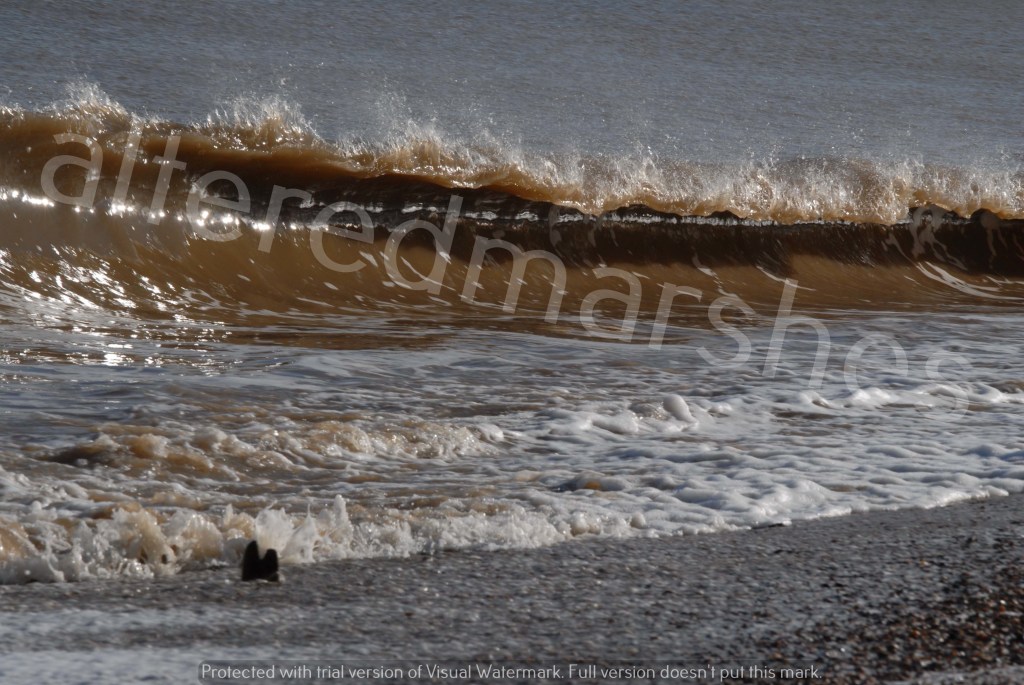
This discussion will look at tides and surges to consider whether the data suggests the presence of conditions likely to cause beach erosion. This will follow-up a previous debate concerning big vs small erosion events, that looked at the transformation of Thorpeness beach, below North End Avenue between 27th August and 1st October 2022.
Values from Spring and Neap Tides will be examined. Spring Tides occur during Full and New Moon, when the Sun and moon align directly with the earth, this considerably increases the height of the tide. Conversely, when the sun and the moon are at 90 degrees, to the earth, a Neap Tide occurs, with an especially small range. Both Spring and Neap tides occur once a fortnight.
Data for five dates selected in the table below, show in the first line for each date, the highest tide value and in the second line the highest surge value. One 13th September the highest tide value is 3.212 metres, and the highest surge value, 0.398 metres. The surge (residual) as it is called is calculated from observed sea level value minus predicted sea level, for the time they occurred.
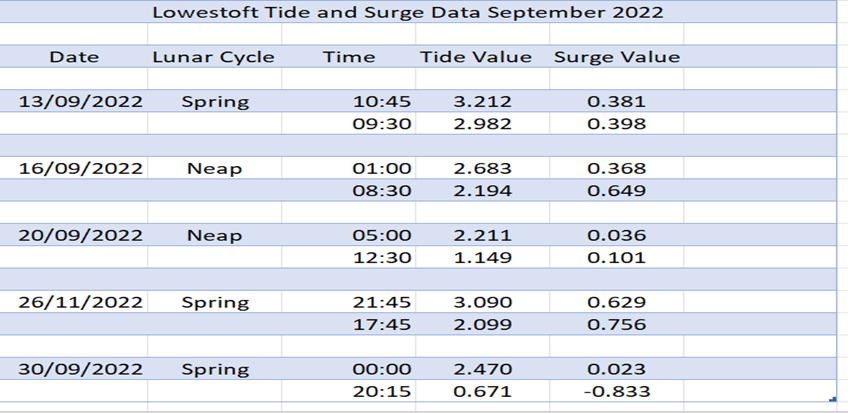
Data obtained from the National Tidal and Sea Level Facility, provided by the British Oceanographic Data Centre and funded by the Environment Agency. The source is the Port, P024 at the site of Lowestoft, with the Latitude of 52.47300 and Longitude of 1.75083 with the start date of 13th September 2022-00.00.00 and end time of 23:45:00 for each date analysed. The Contributor was the National Oceanography Centre, Liverpool and data refers to Admiralty Chart Datum (ACD).
One question to consider is whether surges are independent phenomenon that form as a result of particular conditions. For 13th September, a Spring tide, the surge occurred 1 hour and 15 minutes before High Water. However, it could be said surges originate from the environment at the time, separately from the lunar cycle. On 16th of September, a Neap tide, the highest surge value is 0.649, the third highest surge value in the data above. The surge occurred on a falling tide, at 8:30 am, with a tidal value of 2.194 recorded. The highest tide value occurred 6 and a half hours earlier at 1:00 am and was recorded as 2,683, with a smaller accompanying surge of 0.368. On 26th September a Spring Tide of over 3 metres was recorded, but the two surge values are also both elevated. The highest surge value of 0.756 occurred at 17:45, four hours before high water, with another reasonably high surge of 0.629 recorded at 21:45 at the time of high water.
It is also useful to look at the meteorological conditions at the time the tide and surge values were recorded. A rise in atmospheric pressure causes a 1cm fall in sea level, low pressure causing a rise. As a rough guide, air pressure of 1022 mbar is considered to be High Pressure, 1022-1009 mbar Normal Pressure and 1009 mbar and below, Low Pressure. The table below shows atmospheric conditions for Lowestoft in September 2022.
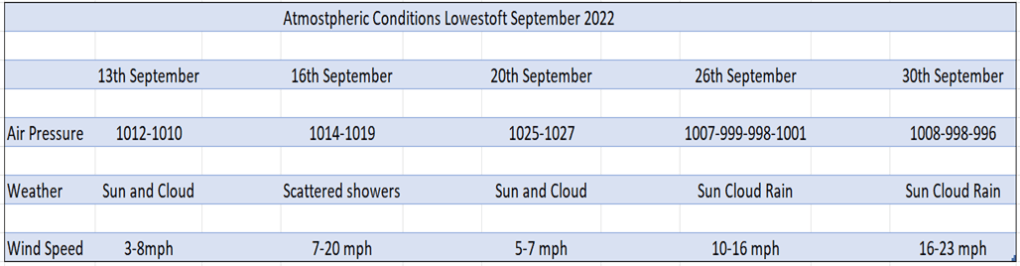
Data of mbar values and weather conditions obtained from the website https://www.timeanddate.com/weather/uk/lowestoft/historic?month=9&year=2022
For 13th– 20th September, Normal or High Pressure was recorded with air pressure fluctuating around 1012-1027 mbar. However, on 26th and 30th September, there is a noticeable drop in Air Pressure, from 1007 mbar to 998 mbar on the 26th and 996 mbar on the 30th. A significant drop in pressure can indicate storm conditions. On the 26th, air pressure at the time the highest surge was recorded was 1000 mbar and by the time of the highest tide it was 1001 mbar, the drop in Low Pressure recorded earlier in the day. On the 30th, air pressure at the time the highest tide was recorded was 1008 mbar and by the time of the highest surge of 0.833 it was 998 mbar.
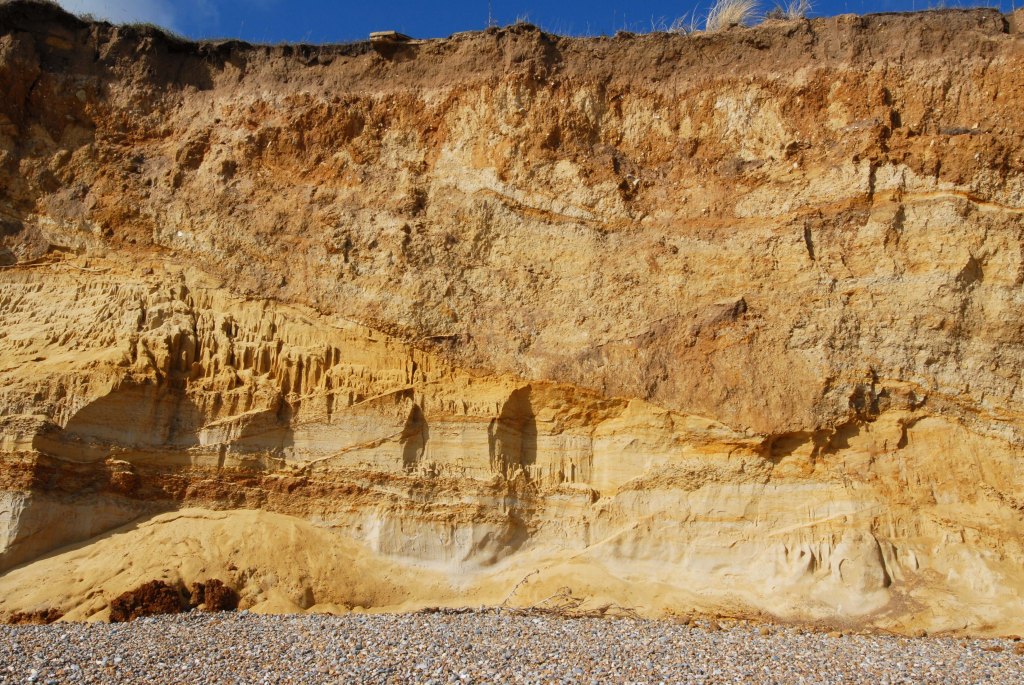
The tide and surge data in this discussion, offers some evidence that certain tides were elevated during September, and it can be seen surges can occur separately from High Water on both Spring and Neap tides. However, for three of the dates considered, it was not obvious conditions were present to produce a surge. But for dates, towards the end of September, noticeable drops in low pressure and stronger winds could have generated surge conditions. Tide and surge values in September and atmospheric conditions don’t provide a causal link between beach changes at Thorpeness and elevated sea states. However, values for 26th and 30th September could suggest an agitated sea state that could move beach material. Though it should be noted tide and surge measurements at Lowestoft are recorded an hour or two before they arrive at Thorpeness. Though it is interesting to consider whether photos of the cliffs at Thorpeness taken on 1st October, show a high-water mark at the top of the cliff. Perhaps concluding the examination of data, atmospheric pressure and the evolving movement of the sea and the land it interacts with.

 alteredcoast