
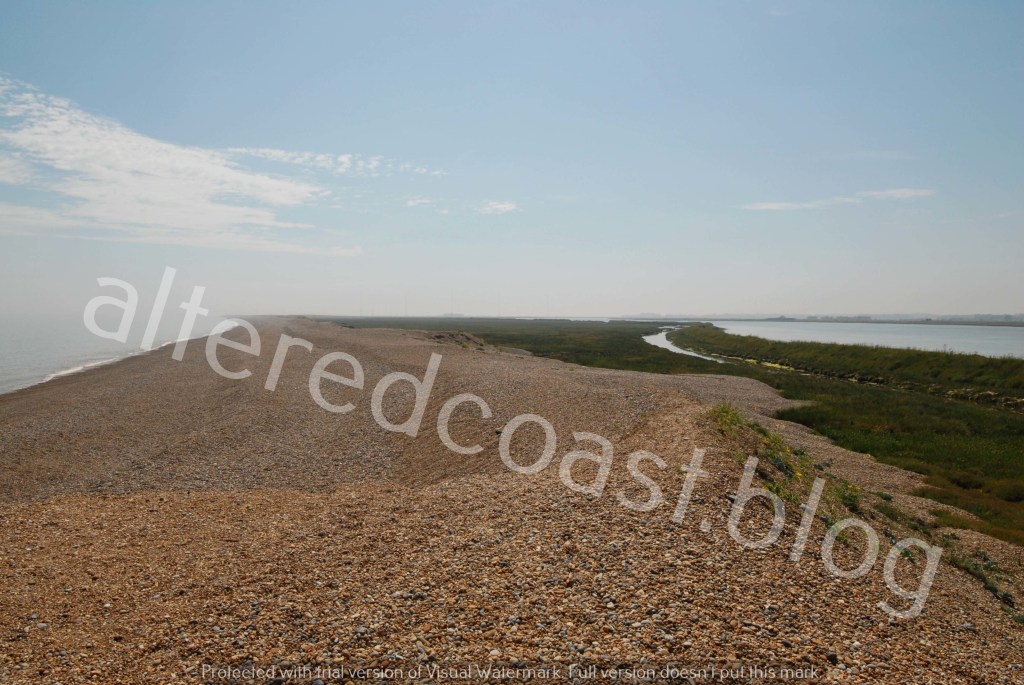
This discussion will consider observations of Sudbourne Beach over the period July 2023 to July 2024. Three points to be considered include alteration to the Morphology (shape) of the Shingle Ridge. The nature of the apparent relationship between the Shingle, Saltmarsh and Tidal water from the Alde & Ore estuary. In addition to the state of the Shingle Ridge protected by defences.
Regarding changes in the morphology of the Shingle Ridge, a photo taken in July 2023, shows the ridge largely intact, with a throat feature. This indicates that a small Overwash could have occurred, which could have pushed a small fan of shingle onto saltmarsh behind Sudbourne Beach.
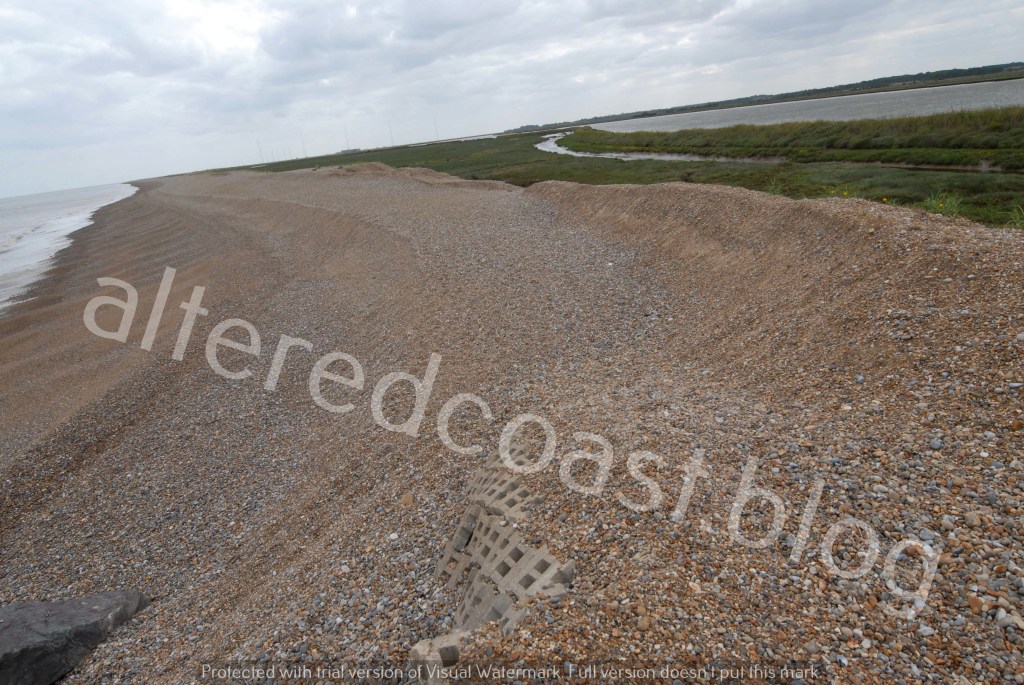
Within a period of four months, a process of more extensive Overwash seems to have occurred.

With a further extension of the shingle fan visible a few weeks later.

The process of Overwashing can occur when wave action, possibly strengthened by storm surges extends over and behind the crest of a shingle ridge. It is not necessarily the height of sea water present, but the fact that waves possess the strength to reach over the top of the ridge and leave sediment in the form of a shingle fan behind the original location of the beach ridge. Instances of Overwashing are distinct from Overtopping, which can involve waves reaching the top of the ridge and leaving shingle, enabling it to accrete (build-up) sediment.
The term Inundation is also used to describe the conditions which cause sea water to sweep shingle down from a ridge. However, as observations of the conditions that caused the alteration of the ridge are not available, Inundation seems rather a blunt, general term, that doesn’t relate more specifically to the situation. It is useful to be aware however, that observations of the wide Overwash of shingle, followed a particularly stormy period, which saw Storm Babet and a very powerful storm surge on November 24th, which caused damage right along the Norfolk and Suffolk coast.
This moves the discussion on to the current relationship between the shingle fan and water from the estuary and at times the sea and the saltmarsh. It would appear there is a regular tide line, which indicates the level of water present, which it is supposed mainly originates from the Alde & Ore estuary. It is supposed water travels up the channel that runs behind the earthen flood defence, that separated the saltmarsh from the Alde & Ore estuary.

It is also possible to observe a channel of water that runs through the saltmarsh from the main channel behind the flood defence and appears to run in front of the edge of the shingle fan. Additionally, it is possible to wonder if scouring of sea water sometimes occurs into the saltmarsh, at the edge of the Shingle Fan.
However, forceful sea water as it slows down, having flowed down the back of a shingle ridge, can let go of the sediment (shingle) it is holding as bedload and lay it down as a sediment fan. The occurrence of scouring or the placing down of sediment, relate to the likely levels of velocity in sea water, once it Overwashes the shingle ridge.
More recent observations also show colonisation of the edges of the pools or channel by saltmarsh, with a more established channel running along the edge of the shingle.

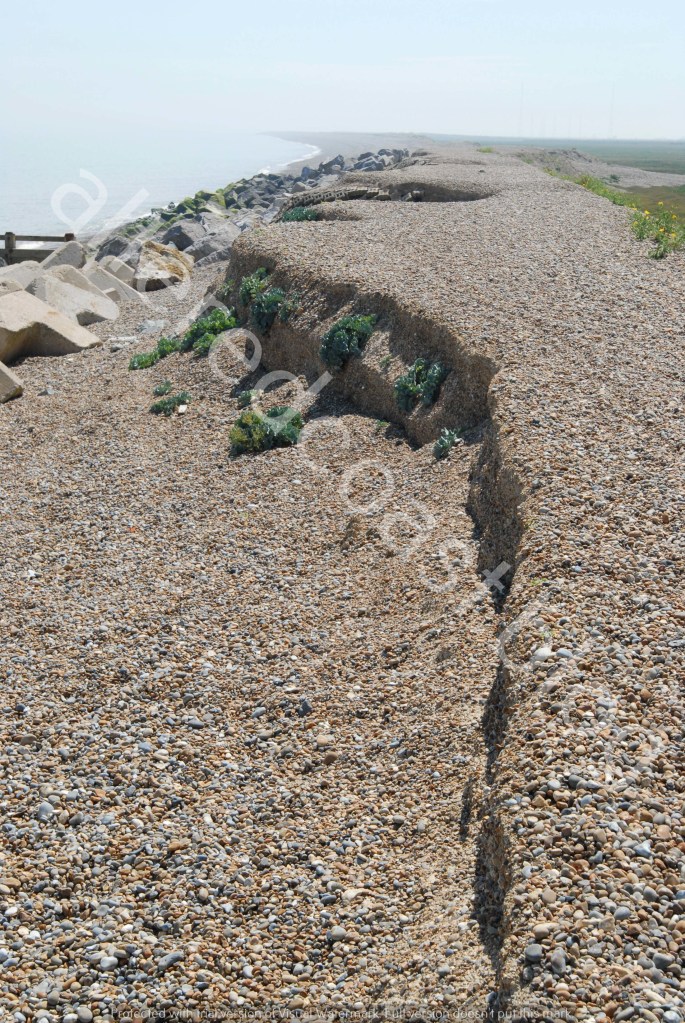
The third point to be considered is the shingle ridge that is protected by flood defences. Methods of protection used, include Cement Mattresses, Rock Revetments and Groynes, but despite the substantial hard defences, in certain sea states, wave action still reaches the top of the ridge. With scouring visible into the shingle ridge behind the defences.

In certain locations, cliffing has occurred, as the ridge of shingle has been eroded. It is thought for such features to form, a certain amount of sand is required to provide the necessary cohesion for the cliff to hold its vertical form. The Shingle Ridge protected by defences is still holding its rigidity but is still vulnerable to wave action. This shows the dilemma with defences or natural beach ridges, as even with protection, the ridge is gradually becoming narrower due to wave action erosion.
Regarding the future of Sudbourne Beach, it could be a question of how the relationship between Saltmarsh, Sediment and the Shingle Fan evolve. If the Saltmarsh is covered frequently with tidal water, this could deposit sediment which could build up the Saltmarsh. Equally, vegetation could begin to colonise the shingle fan, indicating a degree of stability. Additionally, it would seem useful to consider how the shingle fan settles on top of the Saltmarsh and whether this process, lowers or heightens the shingle fan over time.

Related to this, is the development of the slope of the shingle fan that extends down from the backshore of the beach. This could influence the frequency with which waves can travel over the fan from the open coast. As it is perhaps the future behaviour of sea water that extends down the shingle fan, and tidal flows that travels up the estuary that could determine the future of Sudbourne Beach.

 alteredcoast