
Henry David Thoreau, I to Myself, August 1851
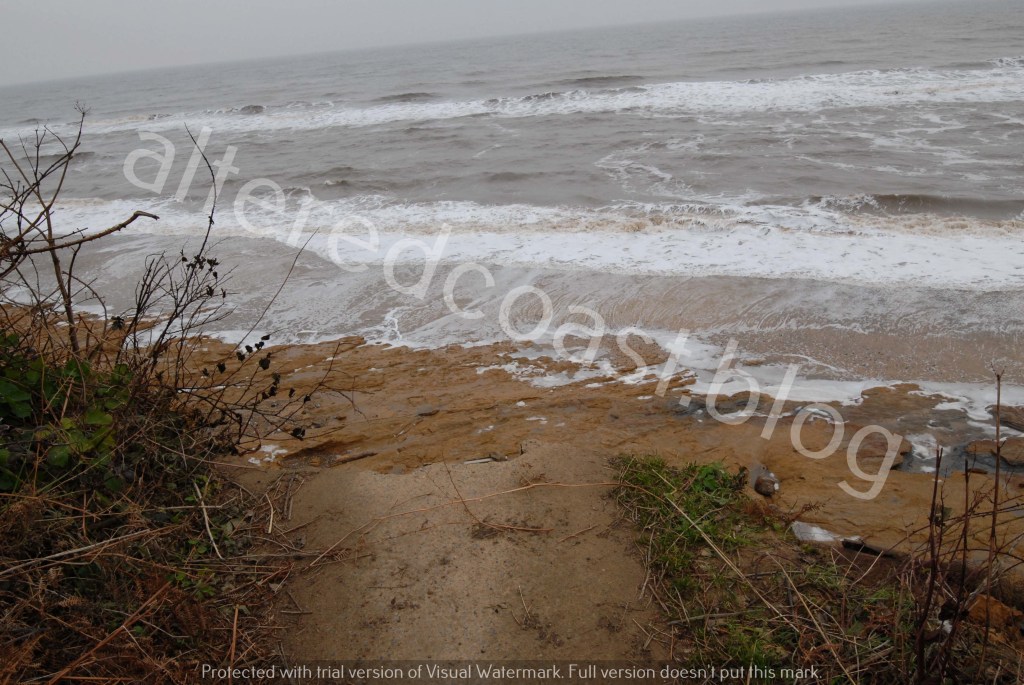
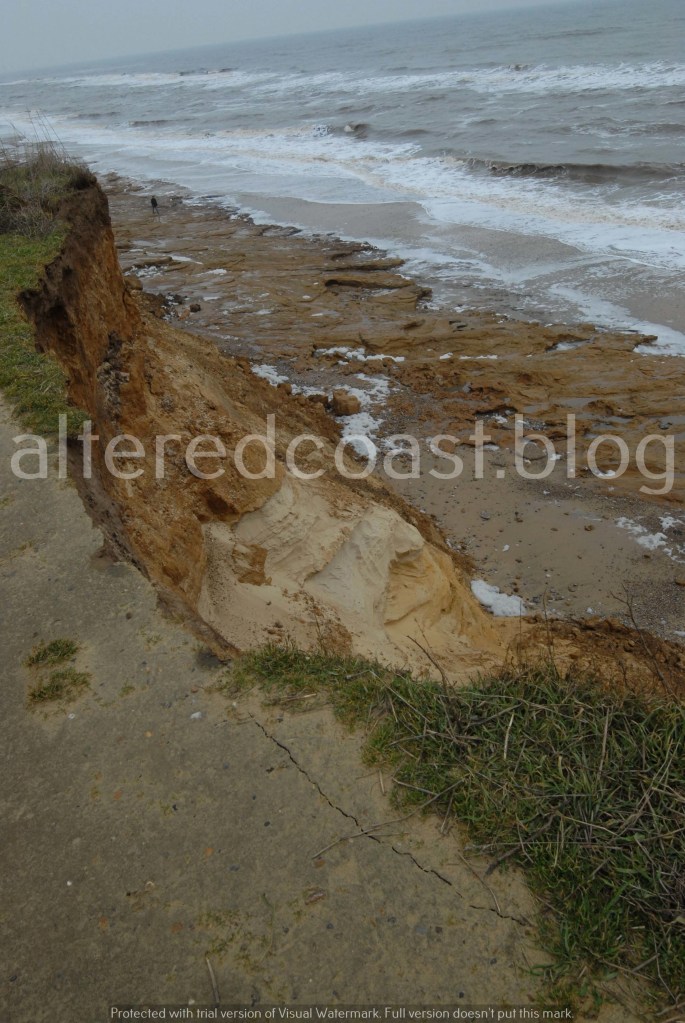
The coastline of Norfolk and Suffolk is bearing the scars of the winter storms of 2024-2025, and this discussion will consider a few examples of the attrition of heavy rain and wave action. Including large slippages of cliff material at Overstrand in Norfolk, with a recent announcement of plans to repair the sea wall. In Suffolk, large cracks were visible at Covehithe at Benacre Nature Reserve. In addition, north of Southwold pier, repairs to fill voids and replace slabs have taken place, following the collapse of sections of promenade. Plans have also been brought forward to repair the toe of the sea wall.
Consideration will be framed around two concepts. The first considers the ghostly image of Dunwich in a painting by Joseph MW Turner, an artistic representation of All Saints church and a reference to the village of Dunwich, that were both lost to the sea. The second concept asks that as churches, such as St Andrews at Covehithe, and communities edge ever closer to the sea. Could it be useful to see through the lens of what has occurred before, to try and interpret the storms of the present to learn anew erosion processes in era of climate change.
To begin by looking at slippage and cracking of cliff structures, it might be useful to consider each element and its impacts on the cliff. Wave action that initially acts at the base of the cliff and rainfall that falls on the cliff top but can seep inwards. Firstly, rainfall and Groundwater which can rise in periods of heavy rainfall, can impact on sediment, to enable one to cause a change in the other. The factor in the middle is shear strength and its ability to resist failures in the solidity of cliff sediment, determined by soil suction and pore water pressure.
Soil Suction describes when sediment becomes saturated, causing air to be lost from pockets in the soil to be replaced by water which in turn causes Pore Water Pressure. This process acts to apply stress due to the volume of water contained in pockets it occupies. This stress is positive if sediment is totally drenched, and pressure is manifold if water cannot increase in volume or flow away through alternative fissures. Pore water pressure can make sediment heavier and reduce its shear strength. The Cliff slippage at Overstrand is thought to be due to the slumping of sediment due to heavy rainfall, with water seen to be running down the cliff.
Concerning Wave action, the tension cracks at Covehithe could be caused by wave action at the bottom of the cliff gouging notches, which could cause slumping of material some metres above.

Significant sculpting of the cliff surface is also visible. Wave action can transmit volatility up through the cliff and this can create tension at the cliff top. Cracks in the cliff could also be caused by heavy rainfall or stress within overhanging section, due to undermining of cliff below.
At Overstrand plans have recently been announced to repair sea wall, so this discussion will move on to briefly consider sea walls, as a means of sea defence.
A sea wall can be viewed as a fixed protective barrier, but as the interface between wave action and sea wall can be a dynamic, unforgiving environment, alterations and repairs are sometimes required.

Reflected wave energy can interact with incoming waves and generate seaward currents that can transport sediment offshore and remove it from the toe of the sea wall. This can undermine or break down sea wall structures.
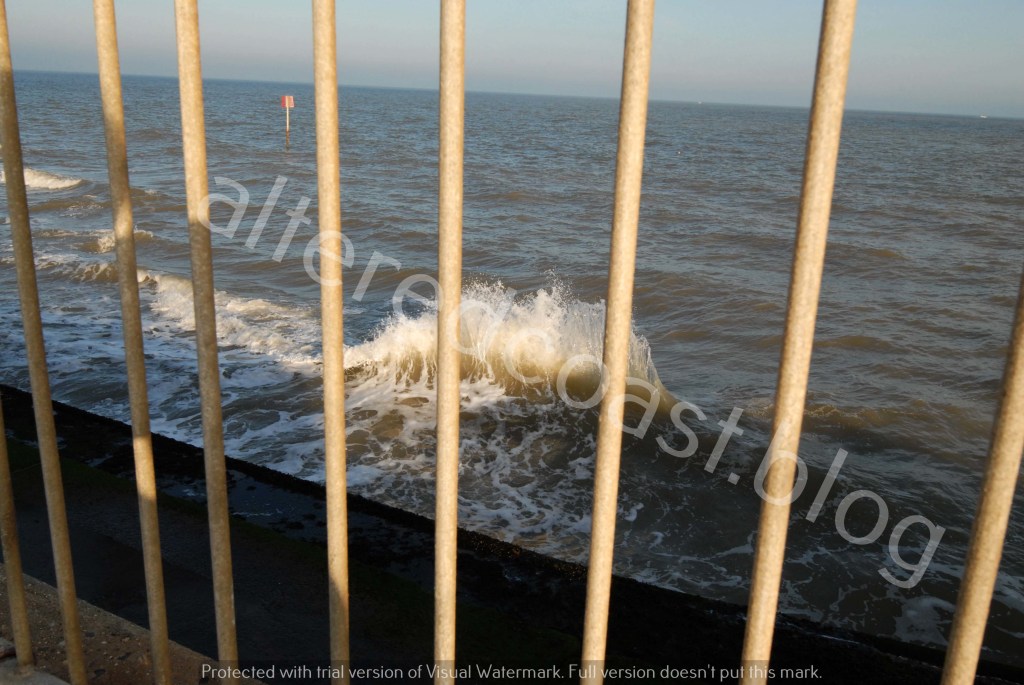
Additionally, waves can transmit energy along the frontage of sea walls, causing erosion at the terminus of hard sea defences.
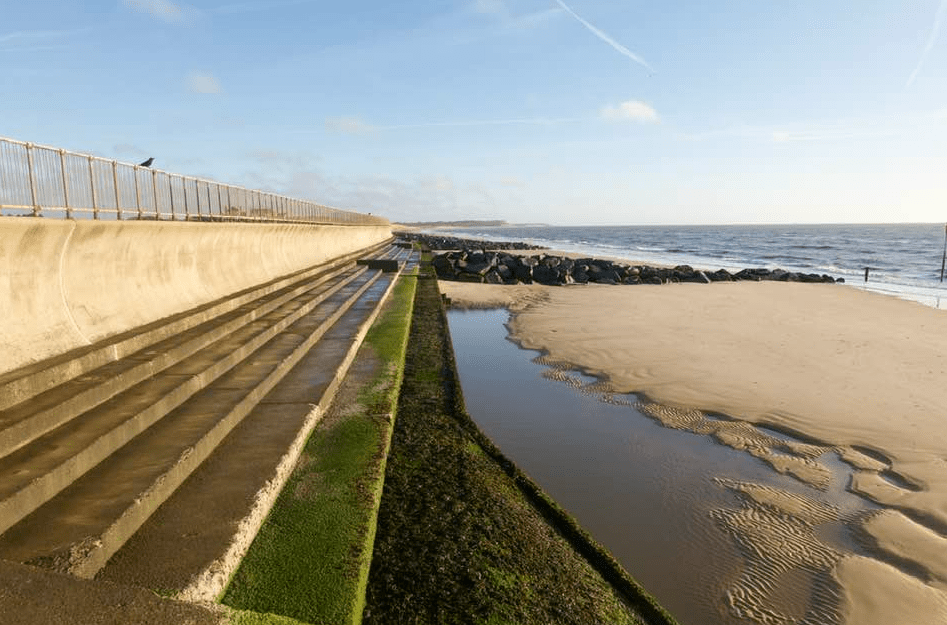
But it is also thought alterations to beaches around sea walls due to storms can be similar to beaches where sea walls are absent, though this depends on availability of sufficient volumes of sediment. Post storm revival can also be similar.
However, as work continues to repair and reinforce structures as storms intensify, it would seem it is a struggle to maintain what is solid and robust, like the slabs on the promenade. Or in undefended locations it is the difficulty to prevent loss of cohesion in cliff sediment causing further slippages and loss of land.
During the time the thriving village of Dunwich was lost, sea defences were scarce and forceful sea water was able to inundate coastal locations. Since these times, with engineering knowledge about hard defences, processes and behaviours relating to sea walls and cliffs were thought to be understood. But under Climate change, the sheer volume of rainfall and the intense power of storm waves, could generate more complex, stronger processes that generate feedback loops with consequences that are harder to control. Under Sea Level Rise deeper water could be present in front of sea walls, with the wave base also growing in depth. As transmission of energy alongside a sea wall, could generate more severe scour in front of sea walls and lower beach levels.
Looking through the lens of ghostly images of lost churches, although the power of the sea has always raged, perhaps it has now transformed into aggregated surplus strength. As increasing volumes of rainfall and forceful wave action, act against soft, erodible cliffs, altering adaption and repair mechanisms. Especially as extreme dry periods can also weaken cliff structures causing desiccated cracking. It could be the combination of excessive dry periods, combined with extreme rainfall and high-energy waves that cause more frequent failures.
Academic articles and a recent television programme on the secret lives of waves, state that it isn’t water that moves but energy that transmits from wind and atmospheric pressures to the sea surface. When considering that it isn’t a question of what you look at, but what you see, perhaps it is the ever active, internal and external working of the aggregated surplus strength of rainfall and energy. Weakening, pounding and altering that what was thought to be solid. Just like the raging storm seas washed away the once bustling key trading port of Dunwich.

 alteredcoast