Perceptions of Erosion

Erosion into shingle ridge, at top of concrete block flood defences, Sudbourne Beach, near Aldeburgh

This discussion is the second of a series, to debate whether big events, such as surges or high waves, or smaller gradual processes, cause the most erosion. This second conversation will look at erosion at Hazelwood Marshes in the Alde and Ore Estuary and Sudbourne Beach on the open coast. These areas have been selected because they provide examples of both small- and large-scale erosion. To frame this discussion, an initial definition of erosion will be used that describes it as a process that takes away physical substances, from the earth’s surface, mainly earth, sand or shingle and conveys this sediment by weather driven process’s such as wind or water from the focal point being eroded.

To begin with a consideration of Hazelwood marshes, it is necessary to acknowledge an immediate contradiction in the context of a discussion of whether erosion is caused by large- or small-scale events. As anyone who knows the history of Hazelwood, knows the reserve used to be a freshwater marsh, but was made intertidal on 5th/6th December 2013, when a large storm surge, caused the embankment flood defences to breach, leading to a permanent inundation of sea water into Hazelwood marshes. Therefore, it could be said that it is case closed, it is the large-scale flood events that cause severe erosion.

But in the case of Hazelwood, since the storm surge breach in 2013, it could also be said it is the gradual, small actions of waves, that could be significant. When you walk along the raised path to the bird hide at Hazelwood, when the tide is coming in, there is a noticeable change as the tide water which has been silently creeping in begins lapping at the side of the bank below the path. It is this constant movement, the tiny incremental expressions of energy, that could be said to be nibbling away at the banks on the reserve.

Erosion on the side of path facing the estuary, on the way to bird hide at Hazelwood Marshes

In the last few months, Suffolk Wildlife Trust who manage the reserve have removed a line of dead blackthorn trees and scrub scoured by intertidal salt poisoning. The materials were removed so they could be used to help support the structure of the path to the bird hide and infill some eroded sections. Erosion of the grass banks at the back of the reserve, below the holiday property, Marsh View is also visible.

Scouring into grass bank at back of reserve at Hazelwood Marshes

It is also noticeable how high the tide line appears to be, continuing the discussion of whether it is significant high water or the gradual actions of waves, that is causing the most erosion at Hazelwood.

High Tide line at the top of eroded grass bank, at back of reserve at Hazelwood Marshes

At the open coast at Sudbourne Beach, it is a more complicated picture. The coast is currently separated by a narrow shingle ridge from the Alde & Ore estuary. On the first section of shingle ridge from the Martello Tower towards Orfordness, various flood defences are deployed, such as concrete mattresses, concrete blocks, and large boulders. However, beyond a certain point, the flood defences stop, and the shingle continues without further defences.

The processes of erosion are two-fold. Above the various flood defences, there is significant scouring into the top of the shingle path, making it quite narrow to walk on. Proof, if it were needed, that the North Sea has never had much respect for flood defences.

Erosion at top of Concrete Blocks deployed as Flood Defences on Sudbourne Beach, near Aldeburgh

However, on the section of shingle not protected by flood defences, the shingle ridge has been pushed quite far back and there is evidence of a recent breach at the top of the ridge that separates the beach from the Alde & Ore estuary. It is likely this breach occurred during the high tides in January and February 2022.

Breach in Shingle Ridge, separating open North Sea from Alde Ore Estuary, Sudbourne Beach

To consider the erosion at Hazelwood Marshes and Sudbourne Beach, it is useful to further develop the definition of erosion discussed above. Whilst it is clear that sediment is being removed from the specific areas discussed, it could be said there is also a process of altering, noticeable losses of solid structures.

Therefore, to conclude the second debate in this series, to consider whether erosion is caused by large scale or small processes, the conversation could simply be a discussion about stages of damage. The incremental continuous damage to coastal features or the sudden forceful visibly recognisable events that create a hole or a channel through a seemingly firm feature. Assessment of this damage, as a one-off specific occurrence, or the culmination of damaging processes, could frame an evaluation of the significance of erosion in vulnerable coastal areas.

Wall Erosion – Hazelwood Marshes

Recent information from the Alde and Ore Community Partnership has found the remaining walls at Hazelwood marshes could be at new risk of erosion. This is due large volumes of tidal water forming waves, which when driven by northerly winds risk weakening the rear inland side of the walls.

Flowers with breached walls in background at Hazelwood marshes

It is thought that there is a dual relationship between the walls being subject to increased erosion and the presence of increased amounts of tidal water at Hazelwood marshes. As the walls weaken, tidal volumes increase in the marsh, which can then lead to increased wave activity impacting the walls at Hazelwood marshes.

Original sea walls, showing signs of erosion at Hazelwood Marshes

Brian Upson owns a boatyard at Slaughden Quay, Aldeburgh, on the bend of the Alde Ore estuary, on a narrow strip of land and shingle, bordered by the open sea on one side and the estuary on the other. Mr Upson believes the tide prism increased once the walls at Hazelwood marshes were breached and was allowed to become intertidal without further intervention.

Slaughden Quay, Alde Ore Estuary

Following the breach at Hazelwood, the boatyard had to go up a buoy size, to keep the boats tethered. The tide could be 8ft at Aldeburgh, in the open sea, 10 ft at Shingle Street, at the mouth of the Alde Ore Estuary, and at Slaughden, the tide could be 9ft. Mr Upson has observed that 3 or 4 ft has been taken off the mud flats, with the disappearance of mud from the bottom of the estuary.

However, the increase in tidal flow at Slaughden is not quantified. A report by Kenneth Pye, on the 2nd May 2014, 5 months after Hazelwood marshes was breached, concluded that there would only be an increase of the tidal prism of around 6-7%, should Hazelwood marshes be left to become intertidal, with no work done to repair breached estuary walls. The tidal prism is the volume of water that comes in and out of an estuary with the rise and fall of a tide.

A cursory look at the tide levels on tidetimes.org.uk and https://www.thebeachguide.co.uk/south-east-england/suffolk/shingle-street-weather.htm, shows that on Sunday 3rd October, for the years, 2021 back to 2019, the height of the tide at Slaughden, either slightly exceeded the height of the open sea at Aldeburgh, or was slightly below it, with the height of the tide at Shingle Street exceeding both of the height of the open sea at Aldeburgh and the tide height at Slaughden.

Graph showing tide tide times at Aldeburgh, open sea, Shingle Street, at the mouth of the Alde Ore Estuary and at Slaughden Quay

The height of the tide is in metres and as can be seen, there is a difference of around 2 hours between high tide at Aldeburgh in the open sea and high tide and Slaughden Quay in the Alde Ore estuary.

Wave breaking on Aldeburgh beach

Regardless of whether an increase in the tidal prism has occurred and the extent to which it is intensifying, what is noticeable is the small signs of increased erosion around the edges of Hazelwood marshes, away from the breached walls at the sea ward entrance to the marshes.

As has been discussed previously on this blog, scouring continues, into the path on the way to the bird hide.

Scouring into path and algae at Hazelwood marshes

Scouring is also occurring into the grass bank at the back of Hazelwood marshes, near a small number of houses.

Scouring into soil at foot of grass bank, Hazelwood Marshes

These dwellings are also adjacent to the river part of Aldeburgh golf course, and not far from the main Saxmundham road into Aldeburgh. This could indicate that a question of how to manage sea water volumes in intertidal areas, is something that will need to be considered in the near future.

Hazlewood – intertidal fortunes

Hazlewood marshes provides unique biodiversity in an environment moulded by its fortunes as an intertidal reserve.

Sediment deposits are accreting at Hazelwood, noticeably in the former freshwater channels. The sediment is thought to consist of estuarine silt, which could concur with analysis that describes the Alde Ore estuary as flood-dominant, i.e that it has a tendency to drop silt.

Vegetation in water channels, Hazlewood Marshes

As part of a report in 2014 by Kenneth Pye Associates, to investigate the implications of allowing Hazlewood to become intertidal, analysis was conducted into the sediment content of the Alde Ore estuary. It was found that sediment in the upper reaches of the Alde Ore estuary, consisted mainly of mud, but sand and gravel could be found in creek beds and in the toe of eroding marsh cliffs. Research has also found that erosion of the north Suffolk cliffs could supply 95% of the mud 89% of the sand and 62% of the gravel sediment found on the open coast and in the estuaries of Suffolk (Burningham, French, 2016).

It could be said, one fly in the ointment at Hazelwood, is that alongside the vegetation, bird, fish and sea life, the activities of the daily tides and the connection to the North Sea continue to shape the landscape.

Flies in spiders web looking out of bird hide on Hazlewood Marshes

The bird hide at the far end of the marshes which affords excellent views across Hazlewood and provides views to Ham Creek in the estuary, gets cut off by high spring tides.

Bird Hide, Hazlewood Marshes

The path to the hide is also being eroded across its width, possibly as a result of dessicated cracking.

Evidence of erosion on the side of path facing the estuary tides, on way to bird hide, Hazlewood Marshes
Erosion on estuary channel facing side of path, Hazlewood Marshes

The same process that contributed to the visible signs along the length of the remaining sea wall at Hazlewood, where evidence of failure of the entire landward facing wall can still be seen.

Evidence of back wall failure on remaining sea wall at Hazlewood Marshes

Sediment accretion and the development of islands, with saltmarsh are known to reduce the destructive energy of tidal waves. However, a report has found that rising sea levels could potentially reverse reductions in wave energy from offshore sand and shingle banks and saltmarsh (Burningham, French, 2016).

In its current form, Hazlewood continues to thrive, and potential exists for discovery of key fish species which are a conservation target for the Alde Ore estuary. But as the saying goes, time and tide wait for no man or living organism, in a dynamic, ever-changing intertidal regime.

Landscapes of marshes and estuary

A selection of photos taken in February 2021 show the current landscape of Aldeburgh Marshes and Hazlewood marshes as well as the history of the scouring effects of the tidal surge in December 2013.

The first photo shows the lasting affects of the scouring of the trees at the back of Hazlewood marshes, alongside the raised islands created more recently by Suffolk Wildlife trust to attract Avocet’s and other birds.

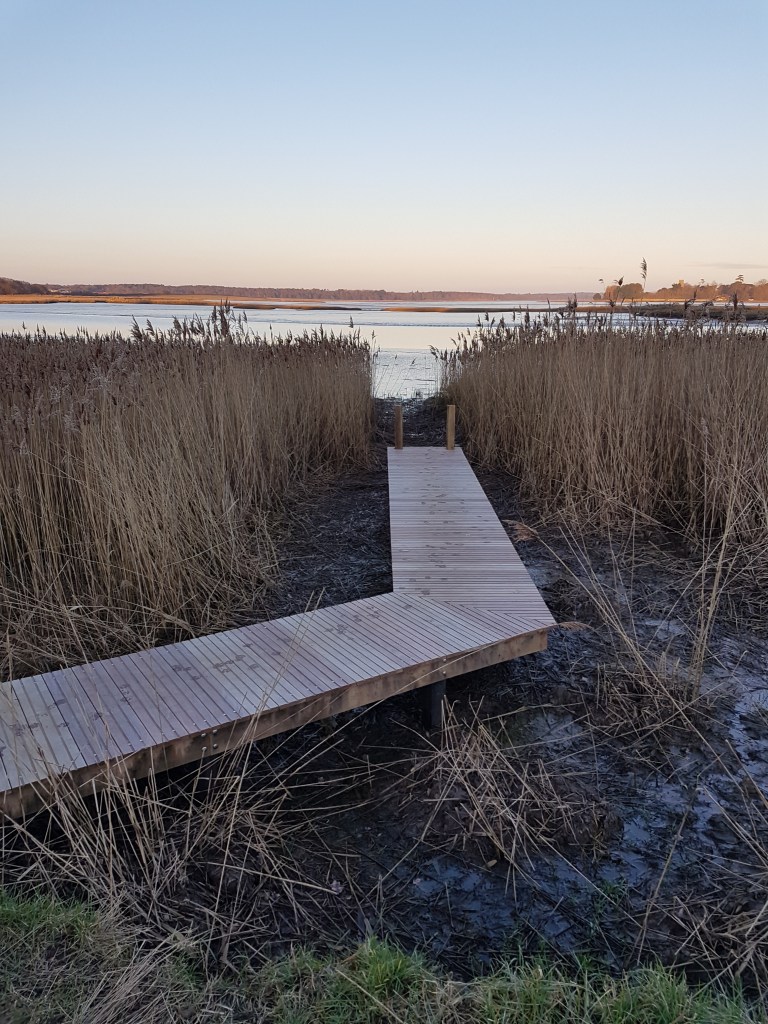
The second photo shows reed beds which have survived at the back of Hazlewood marshes. The Reed beds would have been important habitats for Bitterns when the marshes were freshwater habitats before the tidal surge.

The third photo is taken from the top of the estuary flood defences, looking out to Aldeburgh marshes on the right and the Alde Ore Estuary on the left. The flood defences are built to reduce the effects of tidal surges risking damage to Aldeburgh marshes and town.

The fourth photo looks out on the Estuary at the shore of Iken Cliff, near Snape. Flood defences at Iken marshes, near Iken cliff were subject to partial and actual breaches due to the tidal surge in December 2013. The breaches to the freshwater reserve were repaired quickly, but the area continues to be vulnerable to future breaches due to tidal surges. Flood defences out in the estuary show signs of previous breaches.

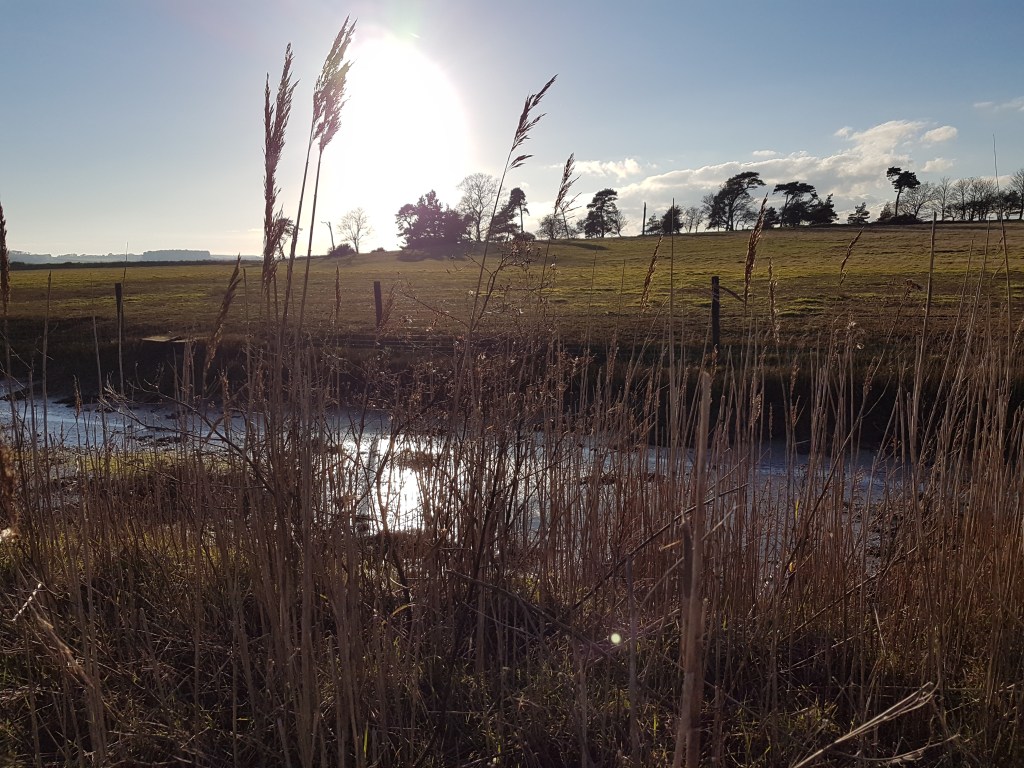
Finally, the peace of the winter sun on Hazlewood marshes, shows a reserve that continues to thrive and is home to many native and migratory birds.  But the area, like the rest of the estuary is subject to the forces of the North Sea and the ability of aging flood defences to withstand rising sea levels and consequent storm surges.

Embankment Wall Breach

In field studies on the Essex and Kent coasts following the North Sea 1953 storm surge, academics, Cooling and Marsland listed four possible causes for flood embankment failure. Three of these causes are particularly useful to consider regarding the failure of river walls at Hazelwood marshes and Havergate Island. These are, a) erosion of sea-facing embankment wall by wave activity, b) erosion of land-facing embankment due to over-topping, c) slippage or slump of land-facing wall due to water dripping through the bank.

The three causes of failure described above can be said to be examples of two distinct processes, Scouring and Desiccating Cracking. Of the causes listed above, a and b, can be associated with scouring and c can be attributed to desiccated cracking. The elements of each process and how they contribute to flood embankment failure will be considered in more detail.

The process of scouring can occur when water overtops a flood defence and reaches the ground on the landward side of an embankment in a state of turbulence, therefore, it could be said, erosion begins the moment the wave reaches the border between soil and water. The force that moves the wave interacts at speed with soil at the base of the landward side of a flood embankment. At this point, two processes are said to be at work, the immediate movement of the water directed by the physical space it hits and the state of the soil when the wave meets the ground.

The immediate area the wave hits is said to contribute to scour due to water meeting an obstruction, presumably this could be a rock or the edge of the base of the river embankment. Meeting this obstruction can interrupt flow and decrease its space and redirect surge water. As this alteration is very sudden and occurs at speed it can multiply the rapidity of the energy directing the water which can cause eddies to form.

The state of the soil the wave meets when it hits the ground, contributes to what is known as shear stress. Britannica.com define shear stress as an energy whose impact can distort a substance causing sliding along a horizontal surface alongside the source of the stress. The shear that occurs correlates to the descending progress of earth impacted by this process. The extent that shear stress causes a deep scour hole is related to the make-up of the soil at the base of the embankment, depending on soil makeup, sheer stress can lead to an eventual lifting of sediments particles causing scour.

A photo that was taken after the storm surge of December 2013 showing evidence of a shallow slippage, caused by scouring after wave overtopping.  

Photo from: https://www.google.com/search?q=AOEP-Estuary-web.4.compressed&rlz=1C1CHBF_en-GBGB894GB894&oq=AOEP-Estuary-web.4.compressed&aqs=chrome..69i57.1077j0j7&sourceid=chrome&ie=UTF-8

The second process that can cause an embankment to breach is Desiccated Cracking. This is particularly said to occur in alluvial clay, a material used in some flood defences in the Alde Ore estuary.

Desiccated Cracking or fissuring relates to the formation of an intersected web of internal vertical and horizontal fissures, about 60 cm deep within the surface layers of a flood embankment. It is thought repeated wetting and drying of estuary embankments can contribute to desiccated fissuring.

In a flood surge, large amounts of water drip through desiccated fissures, in extreme conditions, this can cause hydraulic fracture, when the flow transmits through fissures to the landward side of a river wall. Rather than a wave overtopping, water flows through fissures below the crest, into the embankment. This can cause the lifting of blocks of material, leading to gradual slope failure and the eventual breach of a river embankment.

Photo from: https://eprints.hrwallingford.com/1291/

Regarding, the process of water seepage that causes failure on the land-facing embankment, a member of the Alde Or Association visited Hazelwood marshes during the storm surge at its peak on December 6th 2013. It was reported that the water level reached the top of the embankment with minor overtopping at low points. However, the observation of real interest was amount of free water flowing through desiccation cracking issuing from the landward bank. This is indeed the puzzling aspect that strikes an outside observer of photos of the after-effects of the storm surge at Hazelwood, that they all seem to show water flowing outwards from the land-facing side of the embankment.

Photo from https://eprints.hrwallingford.com/1291/

The two processes of Scouring and Desiccated Cracking are separate yet are linked in that they interact and are influenced by the physical space and soil make-up of the flood embankment they detrimentally affect. Scouring interprets then shapes the space and the particles it interacts with, the scouring out of the base of a flood embankment, being the physical result of this interpretation. Whilst desiccated cracking, develops over time within the structure of the embankment, with the fissures functioning as vehicles for the rapid movement of water and its mechanisms of erosion.  

The tendency of recent storms to become ever more powerful and unpredictable alongside rising sea levels, make the complex processes of scouring and desiccated cracking increasingly useful to understand, so the effects of storm surges can be assessed to reduce the likelihood of flood embankment failures.

Alde/Ore Estuary

The Alde-Ore Estuary, of which Hazelwood marshes is an intertidal component, is long and thin with two main sections. The upper estuary, the Alde refers to the area between Snape and Halfway Reach, an area south of Slaughden next to the radio station below Lantern Marshes. The area of the estuary from Halfway Reach to the sea is referred to as the Ore.

Regarding the two sections of the Alde/Ore Estuary, there are features in each that are worth looking at closely regarding dynamic coastal changes with potential to alter nature reserves and landscapes. The first facing out to the sea, just up from Halfway Reach, is Sudbourne Beach. A rapidly eroding shingle spit, with concerns the sea could forge a permanent breach and enter the estuary landscape.

The second area is Havergate island, opposite the village of Orford. In 2018, the RSPB lowered the sea wall to manage storm surges to channel water into certain lagoons.

Each feature like Hazelwood Marshes is in a process of evolution with the sea shaping and remaking each area, with a constant risk forces could impose a permanent detrimental change. At the same time those keen on preserving each area wish to implement plans to retain the features long term physical presence in the estuary. To consider these processes in more detail each area will be discussed in detail starting with Sudbourne Beach.