Perceptions of Erosion

Erosion into shingle ridge, at top of concrete block flood defences, Sudbourne Beach, near Aldeburgh

This discussion is the second of a series, to debate whether big events, such as surges or high waves, or smaller gradual processes, cause the most erosion. This second conversation will look at erosion at Hazelwood Marshes in the Alde and Ore Estuary and Sudbourne Beach on the open coast. These areas have been selected because they provide examples of both small- and large-scale erosion. To frame this discussion, an initial definition of erosion will be used that describes it as a process that takes away physical substances, from the earth’s surface, mainly earth, sand or shingle and conveys this sediment by weather driven process’s such as wind or water from the focal point being eroded.

To begin with a consideration of Hazelwood marshes, it is necessary to acknowledge an immediate contradiction in the context of a discussion of whether erosion is caused by large- or small-scale events. As anyone who knows the history of Hazelwood, knows the reserve used to be a freshwater marsh, but was made intertidal on 5th/6th December 2013, when a large storm surge, caused the embankment flood defences to breach, leading to a permanent inundation of sea water into Hazelwood marshes. Therefore, it could be said that it is case closed, it is the large-scale flood events that cause severe erosion.

But in the case of Hazelwood, since the storm surge breach in 2013, it could also be said it is the gradual, small actions of waves, that could be significant. When you walk along the raised path to the bird hide at Hazelwood, when the tide is coming in, there is a noticeable change as the tide water which has been silently creeping in begins lapping at the side of the bank below the path. It is this constant movement, the tiny incremental expressions of energy, that could be said to be nibbling away at the banks on the reserve.

Erosion on the side of path facing the estuary, on the way to bird hide at Hazelwood Marshes

In the last few months, Suffolk Wildlife Trust who manage the reserve have removed a line of dead blackthorn trees and scrub scoured by intertidal salt poisoning. The materials were removed so they could be used to help support the structure of the path to the bird hide and infill some eroded sections. Erosion of the grass banks at the back of the reserve, below the holiday property, Marsh View is also visible.

Scouring into grass bank at back of reserve at Hazelwood Marshes

It is also noticeable how high the tide line appears to be, continuing the discussion of whether it is significant high water or the gradual actions of waves, that is causing the most erosion at Hazelwood.

High Tide line at the top of eroded grass bank, at back of reserve at Hazelwood Marshes

At the open coast at Sudbourne Beach, it is a more complicated picture. The coast is currently separated by a narrow shingle ridge from the Alde & Ore estuary. On the first section of shingle ridge from the Martello Tower towards Orfordness, various flood defences are deployed, such as concrete mattresses, concrete blocks, and large boulders. However, beyond a certain point, the flood defences stop, and the shingle continues without further defences.

The processes of erosion are two-fold. Above the various flood defences, there is significant scouring into the top of the shingle path, making it quite narrow to walk on. Proof, if it were needed, that the North Sea has never had much respect for flood defences.

Erosion at top of Concrete Blocks deployed as Flood Defences on Sudbourne Beach, near Aldeburgh

However, on the section of shingle not protected by flood defences, the shingle ridge has been pushed quite far back and there is evidence of a recent breach at the top of the ridge that separates the beach from the Alde & Ore estuary. It is likely this breach occurred during the high tides in January and February 2022.

Breach in Shingle Ridge, separating open North Sea from Alde Ore Estuary, Sudbourne Beach

To consider the erosion at Hazelwood Marshes and Sudbourne Beach, it is useful to further develop the definition of erosion discussed above. Whilst it is clear that sediment is being removed from the specific areas discussed, it could be said there is also a process of altering, noticeable losses of solid structures.

Therefore, to conclude the second debate in this series, to consider whether erosion is caused by large scale or small processes, the conversation could simply be a discussion about stages of damage. The incremental continuous damage to coastal features or the sudden forceful visibly recognisable events that create a hole or a channel through a seemingly firm feature. Assessment of this damage, as a one-off specific occurrence, or the culmination of damaging processes, could frame an evaluation of the significance of erosion in vulnerable coastal areas.

Flood Embankments – cracking in the heat?

In the lead-up to the two-year anniversary of alteredmarshes, a series of discussions will consider whether it is the big storm surge events that cause the most coastal erosion, or smaller processes that develop over a long period, that weaken flood defences and erode shingle and cliffs.

The first of these discussions will consider The Compact Oxford English Dictionary, definition of a crack, which states that a crack is a narrow opening between two parts of something which has split or been broken. The relevance of this description will be considered in relation to the effects of drought conditions on clay flood embankments. The Met Office recently reported England experienced its driest July since 1935, with the driest on record for East Anglia. Met Office maps for actual rainfall show figures in the range of 0 to 25 mm for the Suffolk area in July 2022.

The collapse of a peat levee during a drought in 2003 in the Netherlands, prompted increased research into the effects of drought conditions on peat levees and earthen clay flood defences, such as we have in the UK. A paper Managing drought effects on levees in The Netherlands and England, focuses on a process known as Desiccated Cracking. Clay flood embankments have what is known as a Phreatic Line – a line that separates the section of embankment under water and the area above the water line. When water in a river or lake evaporates, causing the Phreatic Line to drop, areas of earthen embankments exposed above this line, can become subject to metrological conditions.

The effect of drought conditions on earthen embankments is further developed in a paper Experimental and theoretical analysis of cracking in drying soils. A process called Tensile stress can alter the structures of soils on top of earthen embankments. Tensile stress refers to the highest level of pressure soil can bear before it fails. Tensile refers to pressures that are trying to pull the soil to extreme lengths. Therefore, the point when tension within a material exceeds the ability of the substance to resist the pressure.

Once cracks form in the top section of a clay flood embankment, they can extend into the embankment and reach lengths of at least 1 metre deep. If these fissures form a web, this can convert the clay layer into a rubble like material which increases the permeability of the surface of the earthen embankment. Should a flood occur shortly after a drought, water is able to flow through the fissures which can cause the inward collapse of the inner slope by continual upheaval of chunks of rubble-like material.

Grass revetments over the top of clay embankments can also suffer under drought conditions, with substantial retreating of grass coverage, especially if overgrazing by sheep or mowing of grass occurs around the time of drought conditions. However, should rain return, but not under flood conditions, cracks in embankments and grass coverage can recover, but this is not always the case.

However, there are very few examples of earthen embankments collapsing due to drought conditions. Which brings the consideration back to the debate of whether erosion is caused by large scale events or the effect of smaller long-term processes that can cause a flood defence to fail. In some ways, it is a question, of whether the processes caused by drought conditions, cause more damage than the high-energy, high-volume events in storm surge conditions.

In the case of Desiccated Cracking under drought conditions, the process can change the solidity of a soil mass. A process strongly influenced by moisture content in the material, which is why it is particularly applicable to drought conditions.

This is similarly the case with mud flats and open shorelines which could have negative impacts on coastal nature reserves. As estuary levels evaporate, the progression of tensile stress through a soil mass can lead to fissures in established pressure areas. In this context, [Lee et al., 1988], usefully apply the word brittle to describe the soil state. However, in the case of a flat expanse of mud, the ground could also be hard and compacted, with deep running cracks, that make it hard for water to be absorbed, especially in large volumes following a drought.

In conclusion, it is said that water finds its own level and it is the flood events that erode networks of cracks in embankments. However, it could also be the case that the process of desiccated cracking, is itself an early manifestation of erosion that reaches an advanced state and is ultimately concluded by flood events when they happen.

Alde Mud Flats

On the right-hand corner of Iken marshes, there is a freshwater marsh nature reserve, near Stanny House Farm, just below the Alde Mud Flats, on the Alde Ore Estuary.

Sign describing Alde Mudflats Nature Reserve

The reserve is home to Marsh Harriers and Lapwings, as well as Bearded Tits, which nest in the Reedbeds.

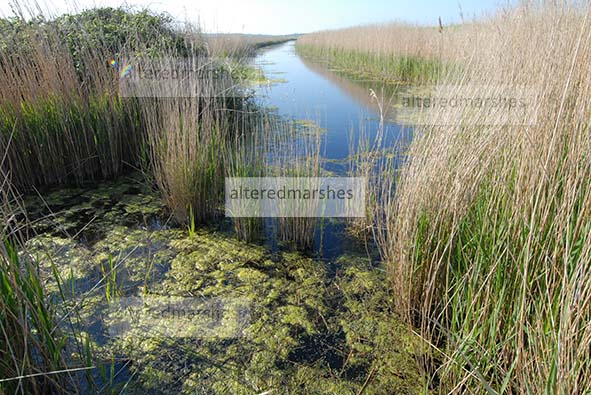
Reed beds in a freshwater channel on Iken Marshes

It is on the right-hand side of what is known as Flood Cell 5. Areas at risk of flooding, on the estuary are divided into cells to assess their vulnerabilities. The reserve offers an example of the use of saltmarsh in front of flood defences. Several studies have assessed the usefulness of this form of flood defence, particularly in relation to sea level rise (SLR). It has been found that saltmarsh can dissipate wave energy, but it is debatable whether this would continue under a SLR scenario. Latest predictions for seal level rise, forecast that Global Mean Sea level could rise to at least 0.29-0.59 m for a low emissions scenario and 0.61-1.10 for a high emission scenario.

Flood embankment separating freshwater nature reserve and saltmarsh on Alde Ore Estuary

It is undoubtedly the case that, where saltmarsh is absent in front of a flood defence, there can be found examples of erosion at the base of flood defences and into the concrete revetment installed as a means of flood defence.

Evidence of tide height and tidal water impact on concrete revetment at base of flood defence

Where tidal water reaches right to the bottom of flood defences, the tide can rise quite high, with the full energy of the waves, potentially weakening structures and embankments.

Erosion at base of flood defence not fronted by saltmarsh

To encourage vegetation as an initial method to develop saltmarsh, groynes are inserted, to enable vegetation grow, in between the groynes and the base of the flood defence.

Groynes placed to encourage vegetation, Alde Ore Estuary

Two studies into the performance of saltmarsh under SLR, have reached different conclusions. A study by Moller et al, found that Saltmarsh offers substantial wave attenuation, even when tide levels are elevated and waves heights increased. When waves compress and rupture vegetation stems, diminishing the loss of wave energy, the actual base of the marsh remains firm and resilient to erosion (Moller et al, 2014).

However, a study by Best et al, concludes that ultimately, saltmarsh vegetation, that form flood defence systems, will be unable to withstand SLR. As wave transportation of sediment to the saltmarsh, increases its height, wave momentum, becomes focused on the Mean Sea level, which can increase erosion. Channels accelerate movement of sediment within the saltmarsh, with increased wave heights decreasing the width and increasing the height of the saltmarsh. Eventually, channel networks reach further towards the land and carve into the saltmarsh. If the saltmarsh is unable to adapt to SLR, vegetation will be pushed towards the land, to accessible areas of higher ground. SLR can increase water levels, enabling waves to travel further into the saltmarsh. A bigger tidal prism, results in greater wave energy, contributing to increased sea facing erosion and further landside sediment deposition (Best et al, 2018).

It is unclear whether this process can be said to be occurring within the saltmarsh at the nature reserve on Iken marshes, near Stanny Farm. A study by Kearney and Fagherazzi, 2016, has found that channels in saltmarsh can encourage the swapping of water, nutrients and sediment amongst saltmarsh and estuary, which can boost vegetation.

Channels in Saltmarsh, Alde Ore estuary

The Iken marshes nature reserve, below the Alde mudflats, provides a good case study of managing saltmarsh and clay embankment flood defences whilst sustaining freshwater reserves. While the nature reserve is a tranquil space, the dynamic of SLR means the nature must co-exist and may ultimately be shaped by the high-velocity tidal systems, already eroding its edges.

Iken Cliff

Iken Cliff, near the Snape Maltings, in the Alde Ore estuary, is an area backed by sandy cliffs, fronted by reed beds and salting’s and boat moorings. One noticeable feature is the presence of breached flood defences. One cause of breaches in flood defences is a process known as desiccated cracking, which involves flood water seeping in through existing cracks, causing weakness and breaches in the landward side of flood defences. Cracking can occur right across the width of the flood defence.

Photo taken at low tide, on the 8th April 2021, on top of an old flood defence.  

Eddies in the water, show levels to be quite high against the tops of old, breached flood defences, as the high tide retreats. The peak of the high tide on 9th April 2021, was at 12:47, and this photo was taken about 50 minutes later.

Breached flood defence shortly after high tide on the 9th April 2021

Figures gathered from tidetimes.org.uk show approximate daily tide times and levels. On the 9th of April 2021, the high tide was 2.76 metres, which was the highest for the 9th of the month for 2021. But in comparison to figures from the 9th of the month going back to 2019, the tide on the 9th April 2021, was the lowest. In 2019 the high tide at 16:39 was 2.77 metres, and in 2020 the tide at 15:02 was 3.08 metres. Interestingly, the low tide on 9th April 2021, was highest measurements for a low tide for 2019 and 2020. In 2019, the low tide at 23.02 was 0.75 metres. On 9th April 2020, the low tide at 21.32 was 0.62 metres. However, the low tide on 9th April 2021 at 19.18 was 0.98 metres.

Figures that give rough idea of tide times on 9th April in from 2019 – 2021. Sourse of data: tidetimes.org.uk

Water partially covering the path by the side of the estuary indicates a high tide can reach right to the edge of the estuary space. Sections of path fronted by reed beds and salting’s, showed much less surface water, which suggests vegetation can act to limit the reach of tidal waters.

Path partially covered by tide water. 9th April 2021

The composition of Iken Cliffs is very sandy, though there is overgrowth and large tree roots which can add structure. But the ever-present erosion risk is indicated by warning signs to passers-by.

Sign on Iken Cliff warning of cliff erosion. 9th April 2021

There are long-standing flood defences at the bottom of one part of Iken Cliffs and it looks possible that these defences and the trees in the flood defence and the grass may resist any rising tide. Though the top of the flood defence and bottom of the embankment could be vulnerable to scouring by flood waters as well as desiccated cracking, as a rising tide does not necessarily have to overtop to weaken a flood defence to cause it to breach.

Tyres and small boulders at base of earthen flood defences. 8th April 2021

One of the special features of the Alde Ore estuary are the seals, and this photo shows a seal in the foreground resting on an island, with another seal swimming behind. It is a nice peaceful estuary image to conclude on, aside from the turbulence of tidal erosion, past and present.

Seals at Iken Cliff in Alde Ore Estuary. 9th April 2021

Landscapes of marshes and estuary

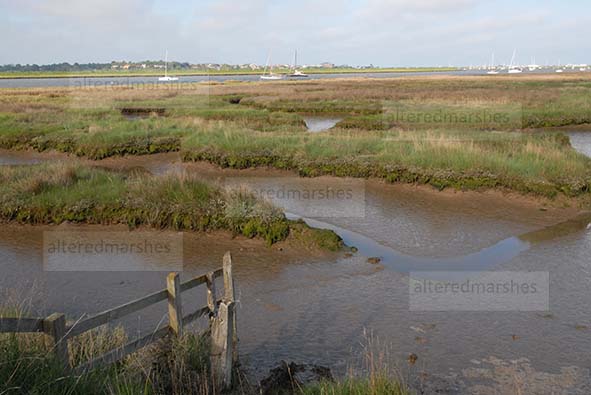
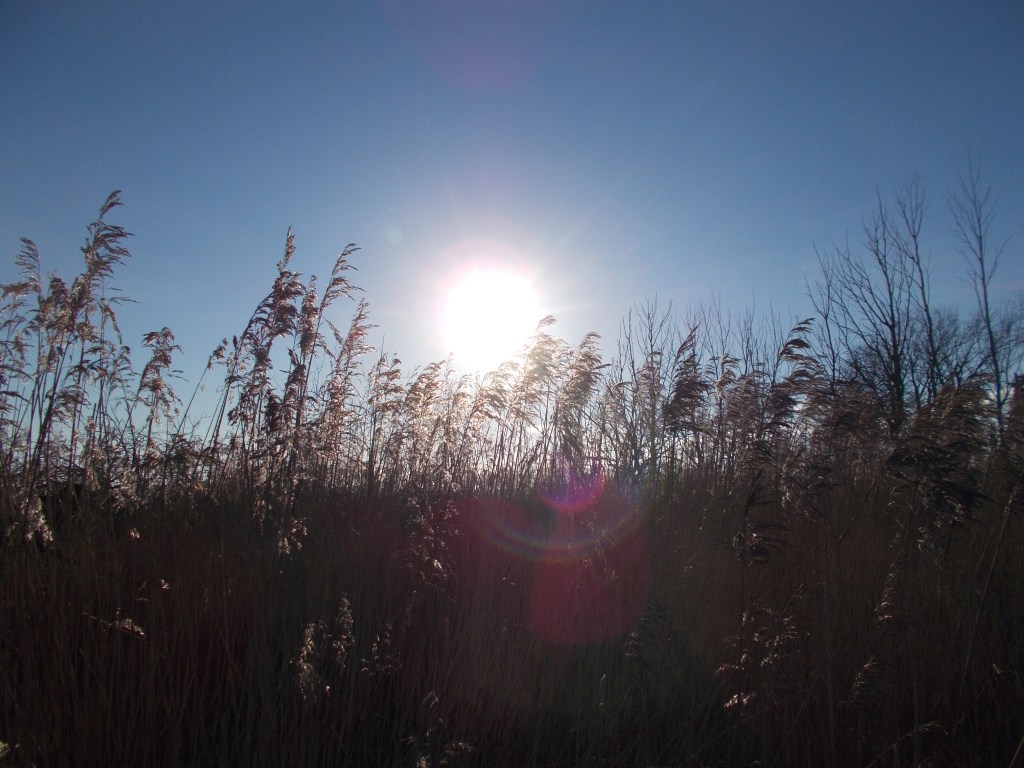
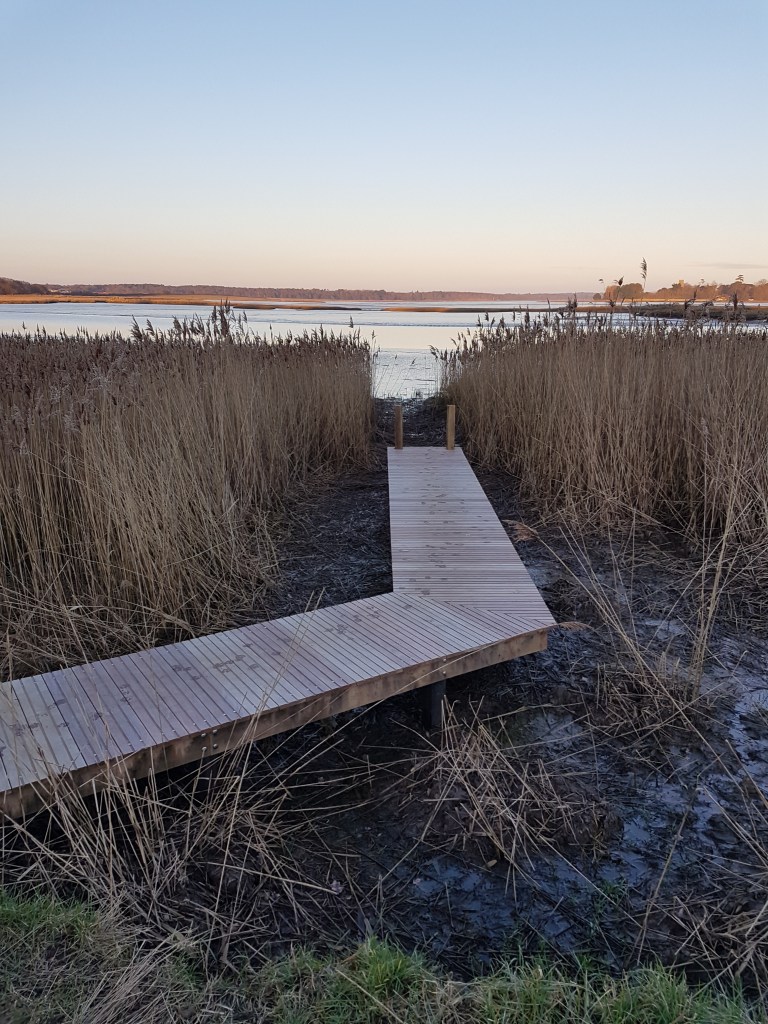
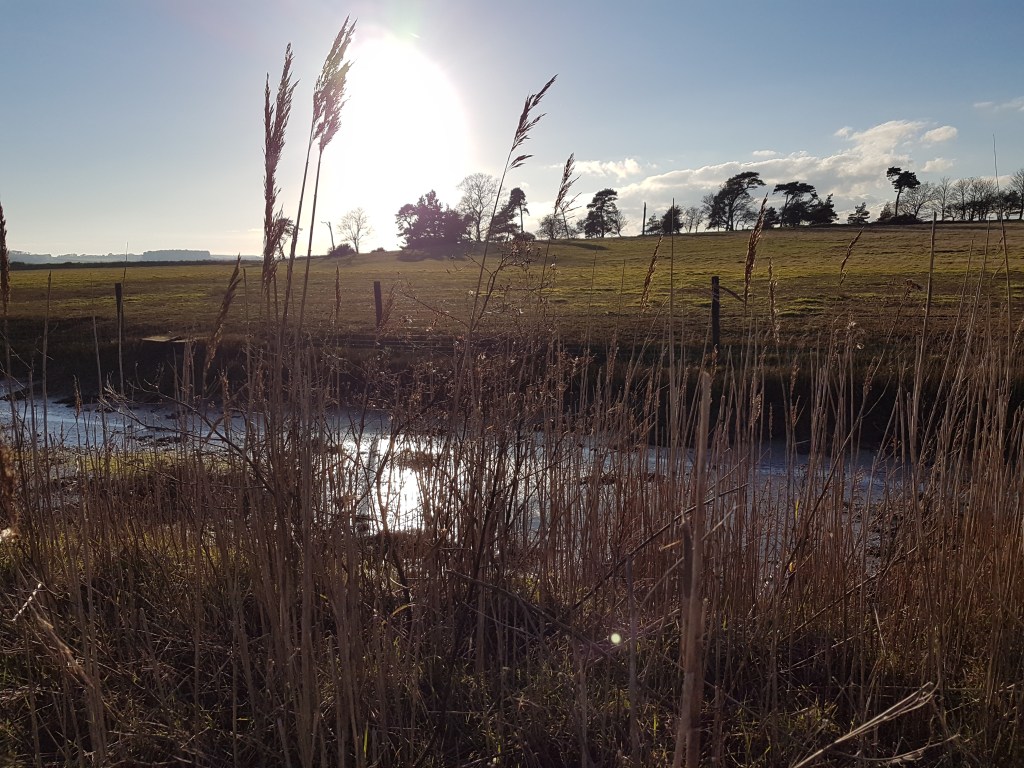
A selection of photos taken in February 2021 show the current landscape of Aldeburgh Marshes and Hazlewood marshes as well as the history of the scouring effects of the tidal surge in December 2013.

The first photo shows the lasting affects of the scouring of the trees at the back of Hazlewood marshes, alongside the raised islands created more recently by Suffolk Wildlife trust to attract Avocet’s and other birds.

The second photo shows reed beds which have survived at the back of Hazlewood marshes. The Reed beds would have been important habitats for Bitterns when the marshes were freshwater habitats before the tidal surge.

The third photo is taken from the top of the estuary flood defences, looking out to Aldeburgh marshes on the right and the Alde Ore Estuary on the left. The flood defences are built to reduce the effects of tidal surges risking damage to Aldeburgh marshes and town.

The fourth photo looks out on the Estuary at the shore of Iken Cliff, near Snape. Flood defences at Iken marshes, near Iken cliff were subject to partial and actual breaches due to the tidal surge in December 2013. The breaches to the freshwater reserve were repaired quickly, but the area continues to be vulnerable to future breaches due to tidal surges. Flood defences out in the estuary show signs of previous breaches.

Finally, the peace of the winter sun on Hazlewood marshes, shows a reserve that continues to thrive and is home to many native and migratory birds.  But the area, like the rest of the estuary is subject to the forces of the North Sea and the ability of aging flood defences to withstand rising sea levels and consequent storm surges.

Havergate Island

Havergate Island is situated near the Suffolk village of Orford, at the meeting of the Ore and the Butley rivers.  The Ore divides in two around the two-mile long Havergate Island with flows splitting through what is known as the Gull on the north side of island and the Narrows on the south of island. Coriolis forces, roughly defined, state a force influenced by the earth’s rotation tends to deflect moving elements to the right in northern hemisphere and to the left in southern hemisphere. Such forces would suggest flood tidal flow would run through the Narrows and ebb flow through the Gull. Both flows are similar in width, but the Gull is much deeper.

A video, kindly provided by the RSPB taken by a warden at Havergate in 2019, shows a breach caused by a sea surge. The breach was at the narrowest part of the island, on the side facing the Gull, on Havergate Island.

A large sea surge in December 2013 breached the sea walls at Havergate. In order to limit damage from any future surges, the RSPB, introduced a scheme to allow certain areas (known as ‘sills) to overtop. The purpose is to allow the sills to flood in a relatively controlled manner to manage water inundation and enable areas recover relatively quickly.

This approach seeks to address the problem of storm surge sea water once it enters a reserve scouring (eroding) the insides of sea walls fundamentally weakening them. When this occurred during the December 2013 storm surge, the RSPB at Havergate built up damaged walls, but are aware the walls may never be as strong as they were.

Internal scouring of sea walls was one of the main causes of damage following the 2013 surge. As the reserve contains saline lagoons the flooding of salt water wasn’t as damaging as it was to the freshwater marshland at Hazelwood marshes. Wildlife has also recovered following the 2013 surge with the hare population recovering and uncommon yellow vetch growing again.

As the RSPB have lowered sections of the sea wall, they are able to utilise sluice gates to allow flood water to leave lagoons without surges causing lasting damage. The process for creating the lower sea walls in addition to reducing wall height involves laying wire netting on the lowered sea wall and sowing grass seed. Once the grass has grown, combined with the wall lowering and the net laying, it should enable defences to withstand several hours of overtopping. Such schemes are favoured as they enable constructive management of overtopping. Which often proves cheaper than dealing with breaches in sea walls which are seen as more damaging and costly to fix.

Regarding the future of Havergate Island, it has been predicted by site manager Aaron Howe that the reserve could have another 20-40 years before it succumbs to coastal erosion. Increasing storm surges and rising sea levels are developing alongside another process, known as Isostatic Rebalancing. This refers to the post-glacial rebound of northern Great Britain which is said to be happening at a rate of around 10cm per century. This is causing a corresponding downward movement of the southern half of Great Britain, which is developing at around 5cm per century. This could increase the risk of floods in southern England.

The sea is nibbling away at Havergate, and the RSPB believe tidal surges are increasing, but the wardens and site managers work hard to adapt and evolve. As do the many bird and wildlife species the island is famous for. In this way, Havergate, placed as it is, in the middle of a tidal estuary shaped by the North Sea, serves as a barometer of the evolution of tidal reserves and species, and the size and nature of sea surges. Like the boat October Storm that takes visitors, to and from the island, Havergate is pushing into its tidal fortunes, to innovate as currents and surges shape its environment.