Erosion and Demolition at Thorpeness

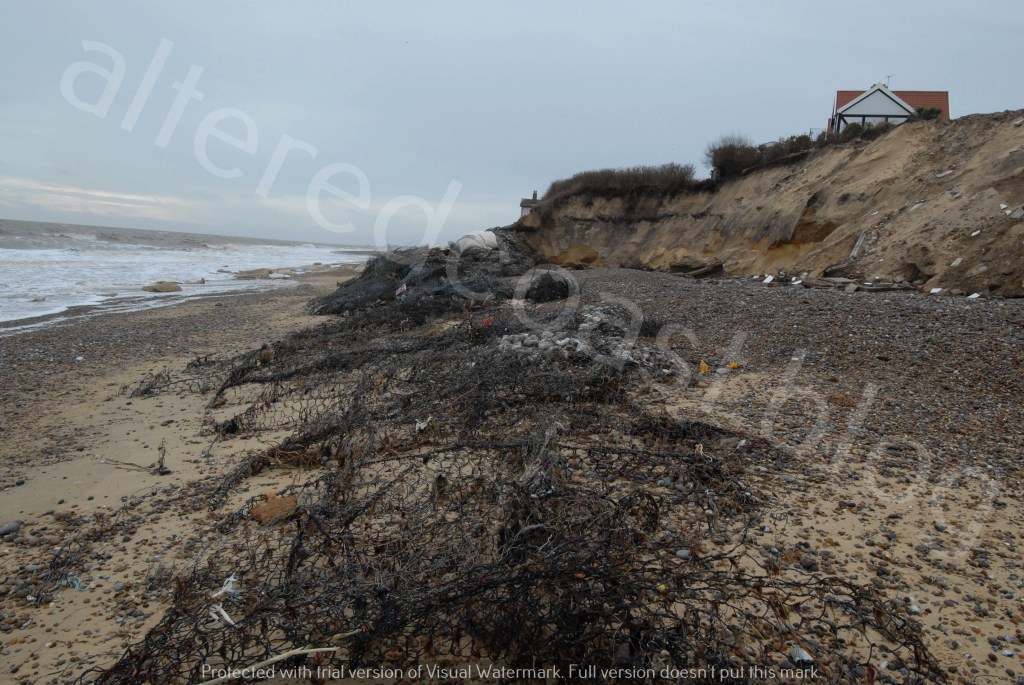
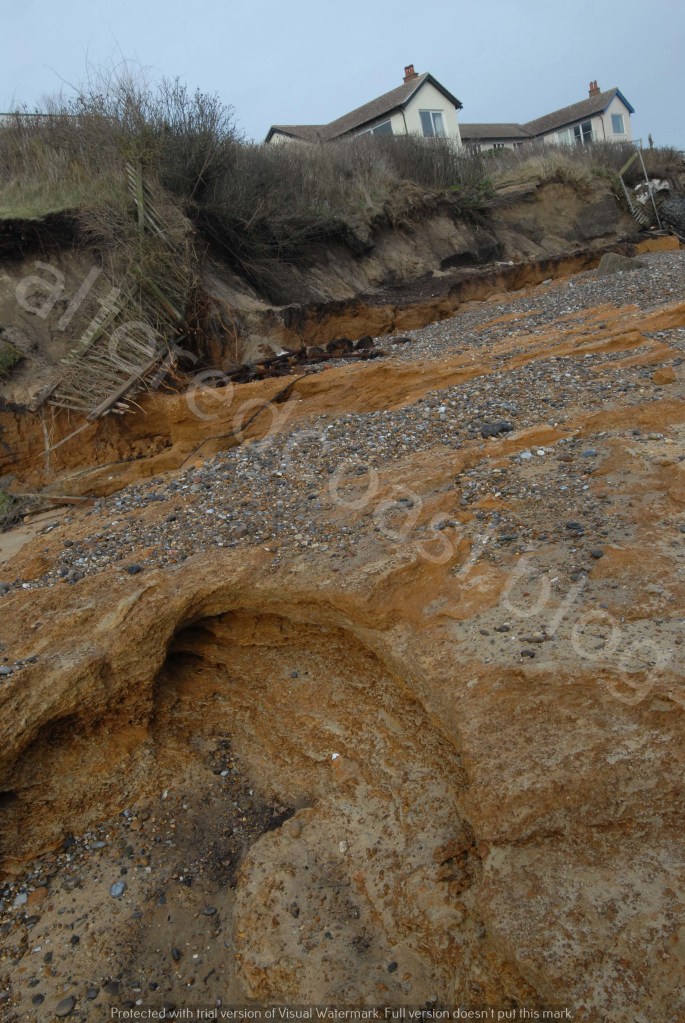
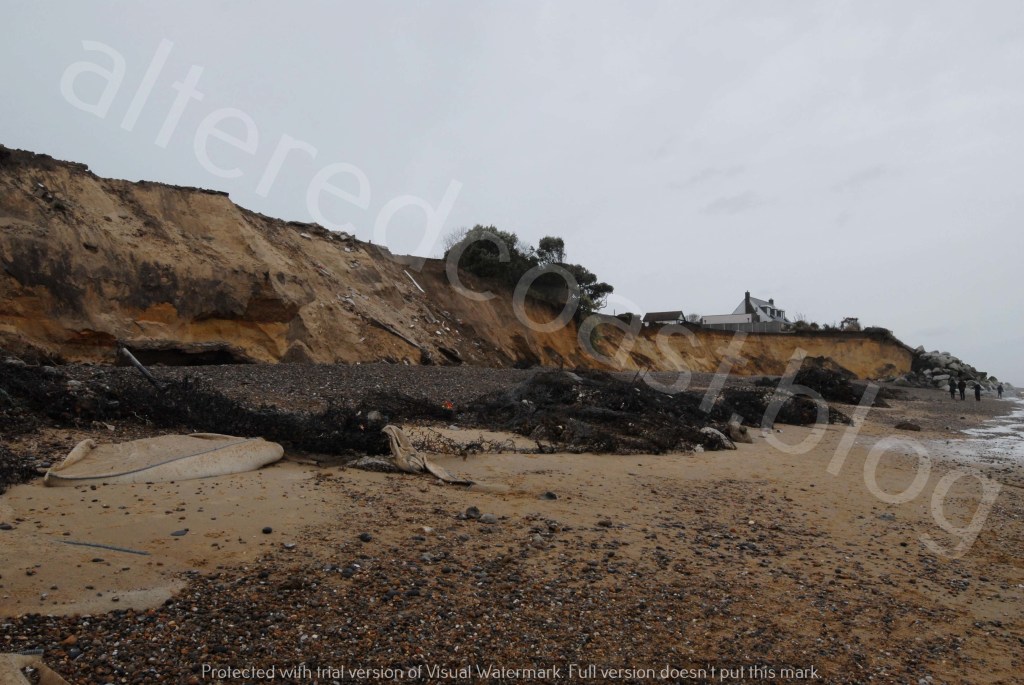
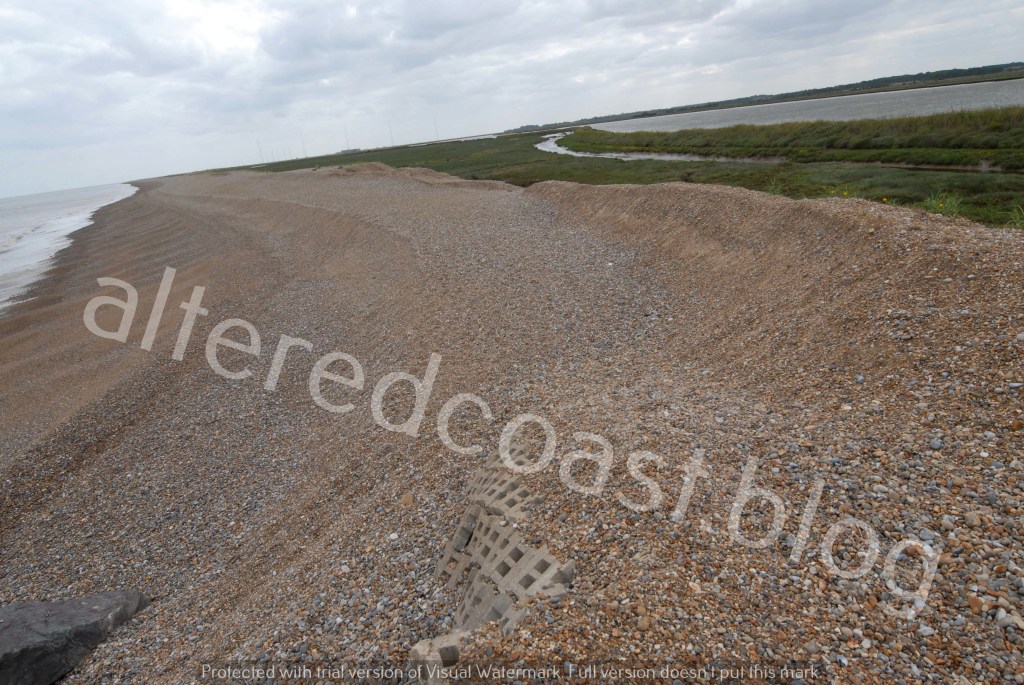
Image of properties that have recently been demolished, with The Chantry in the foreground and The Warren just visible above the severe erosion and cliff retreat. With broken Stone Basket Gabions on the beach. 18th October 2025.

Severe erosion sadly continues to see demolition of properties on North End Avenue at Thorpeness. It is thought a further 6-8 metres of cliff has been lost over the last two months.

This cliff retreat is in addition to loss measured by coastal managers, for the location south of the rock revetment at Thorpeness Beach, the site of the most recent demolitions. For monitoring purposes, the area is categorised as Transect SO38, and retreat of around 20 metres is assessed to have occurred since the first survey in 1991.

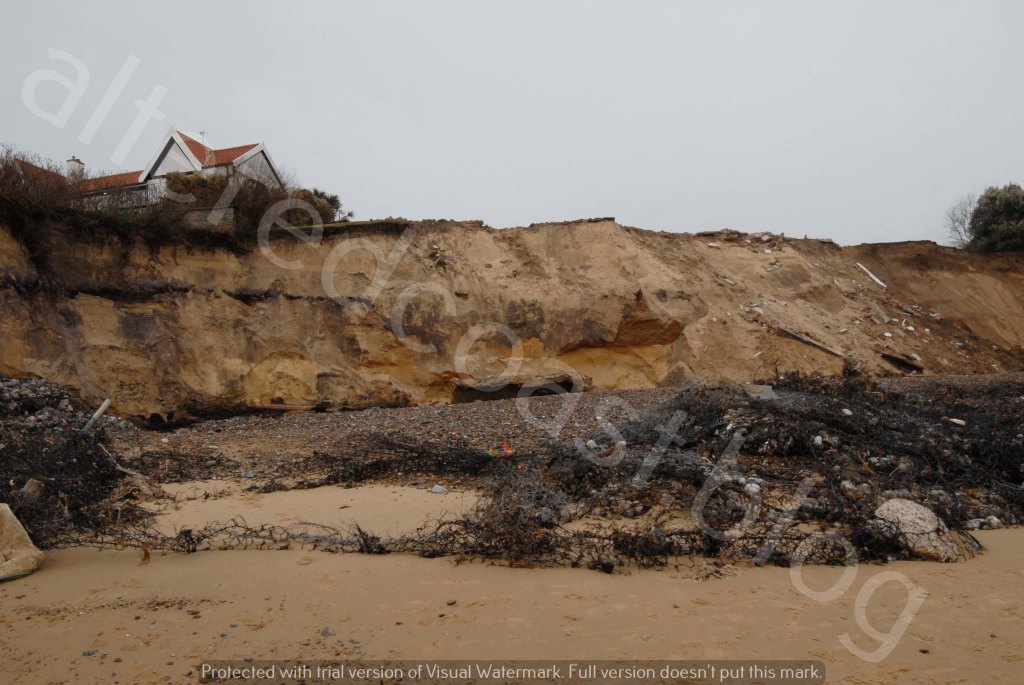
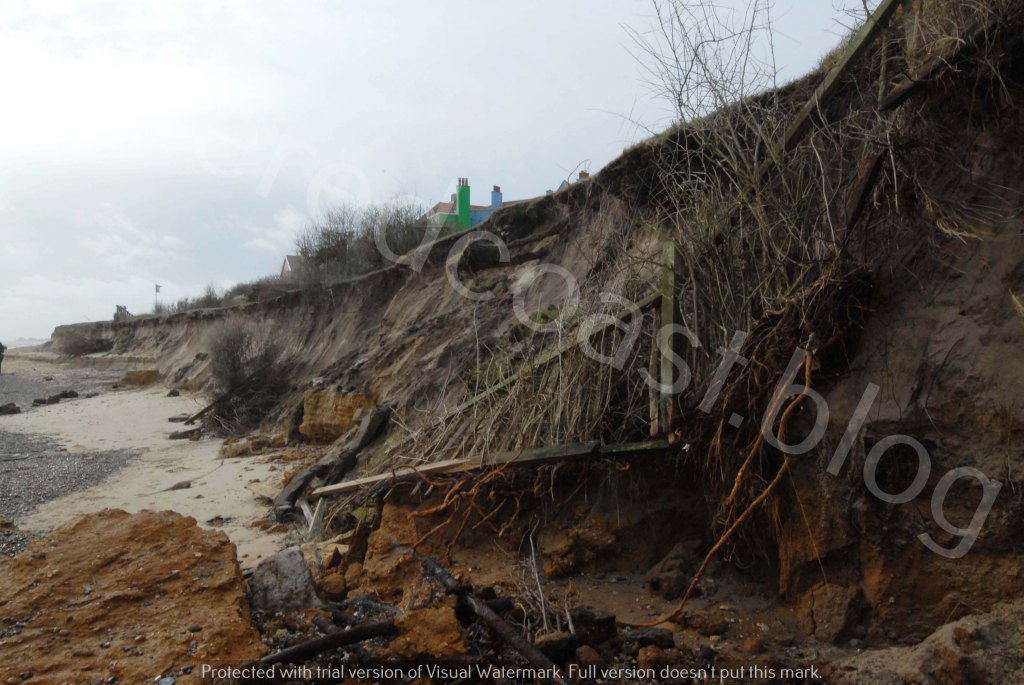
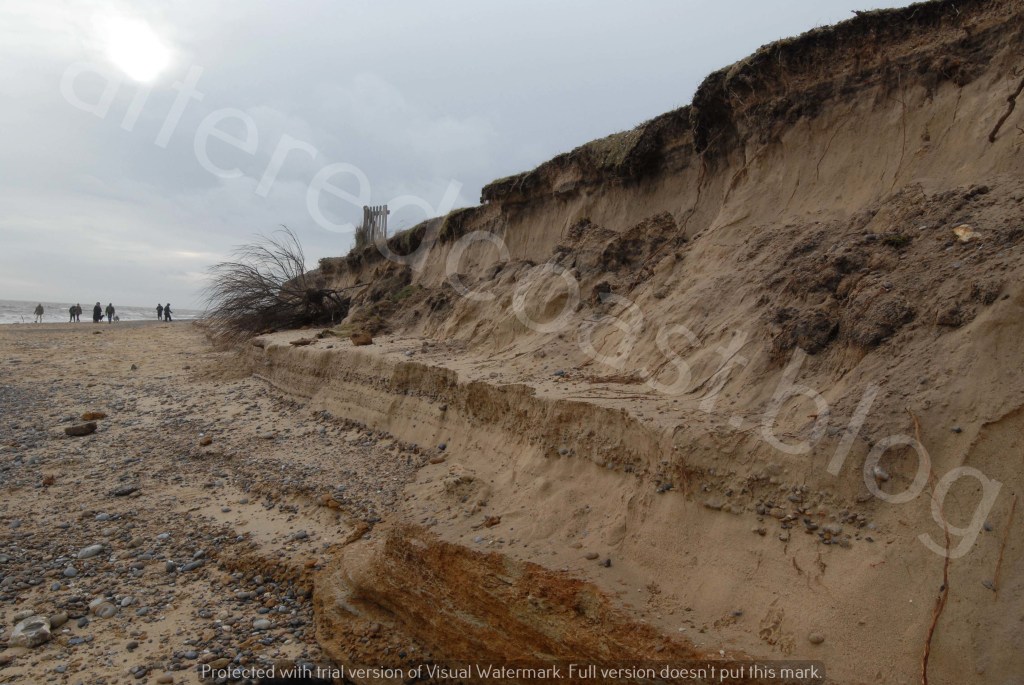
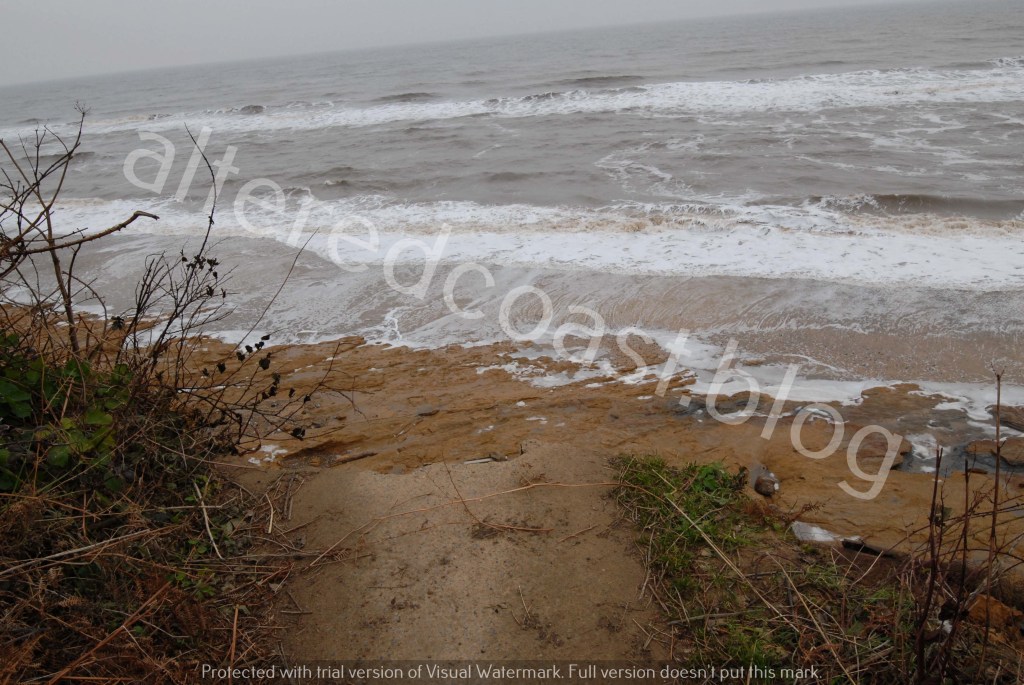
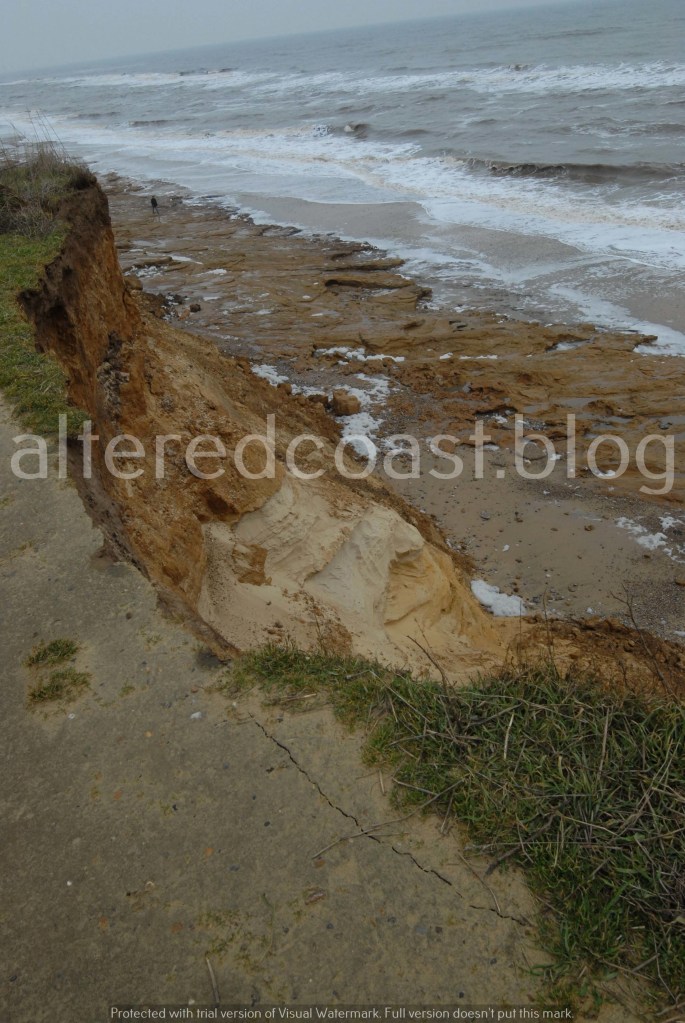
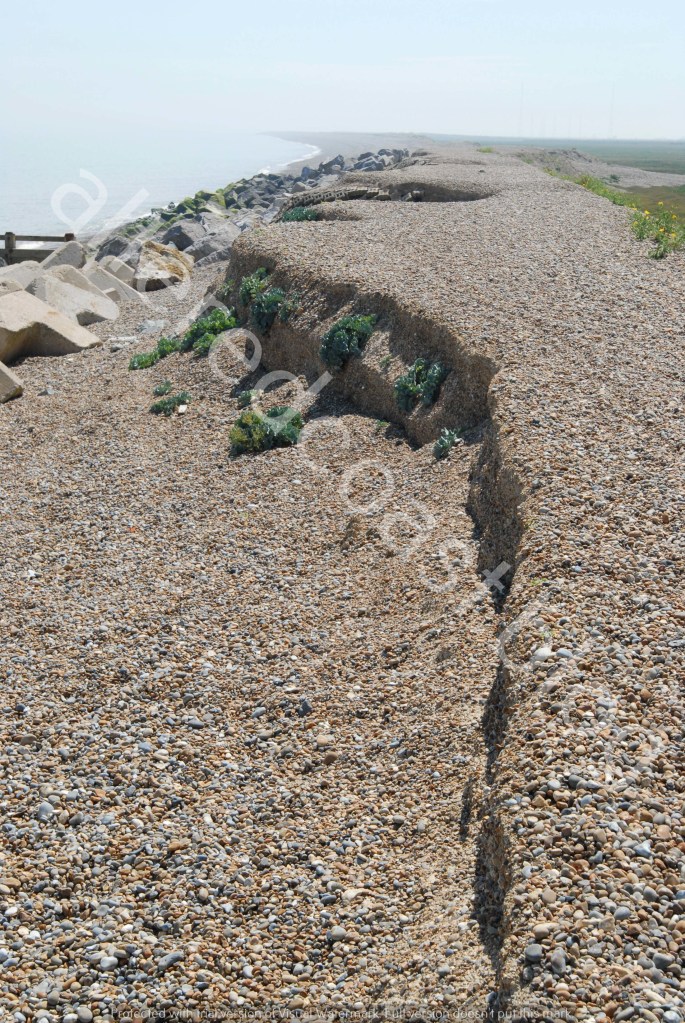
As a physical contribution to attempts to understand the erosion, a photo taken in late December 2024, could hint at early processes at work immediately south of the rock revetment on Thorpeness beach. It appears wave action was reaching beyond the Gabion stone baskets and starting to erode into the face of the sandy cliffs.

Erosion into the cliff face behind broken Stone Basket Gabions, south of the rock revetment below North End Avenue, Thorpeness. Suffolk, East Anglia, UK. 30th December 2024.

This location, and Thorpeness Beach more generally, can be a very high-energy environment. Conditions made all the more dynamic by the increasingly intense storms that hit the UK. Severe erosion at Transect SO38 is thought to have occurred between December 2024 and April 2025. But winter storms to date in 2025 could have worsened the erosion.

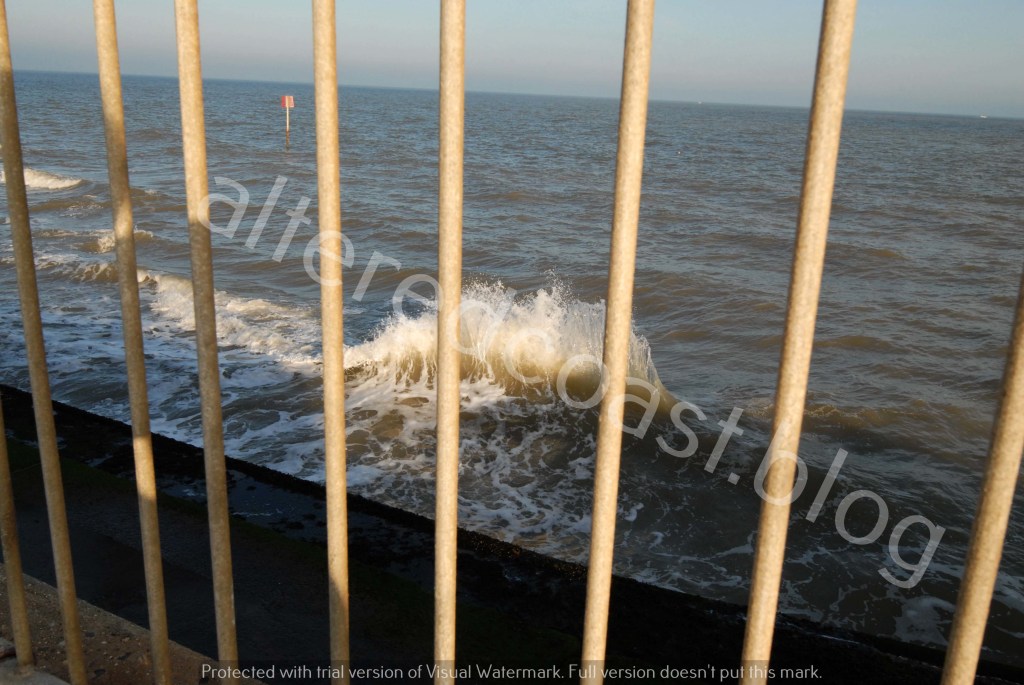
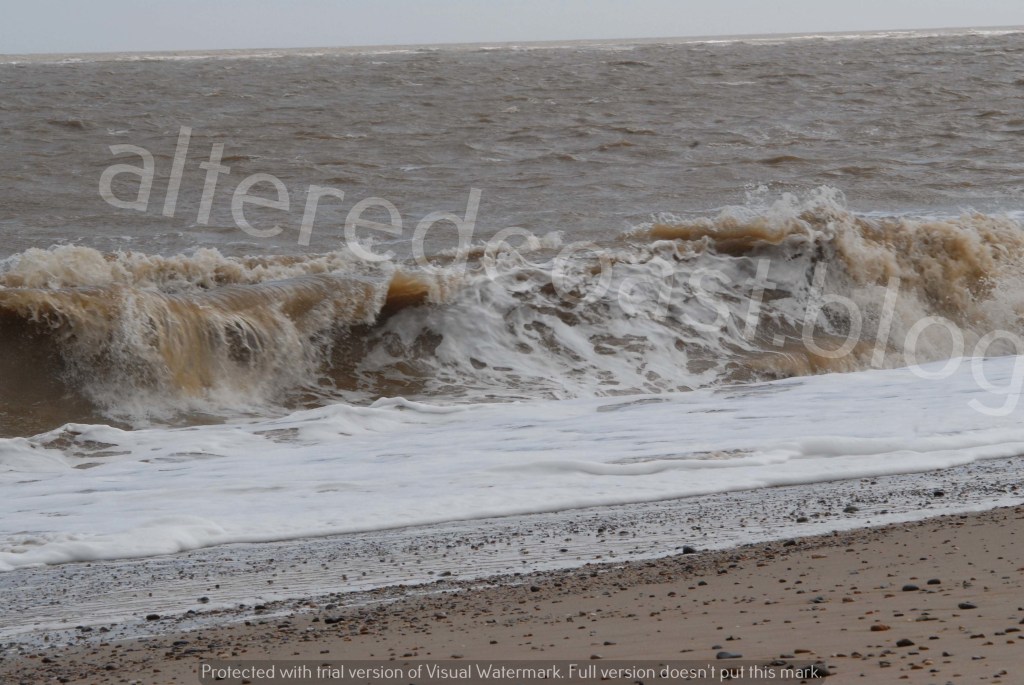
Waves breaking in front of broken Stone Basket Gabions at the entrance to the site of severe cliff retreat that has led to recent demolitions. 23rd November 2025.

Storm Claudia hit the UK on Friday the 14th of November 2025. The Shipping Forecast predicted Gale Force 8 wind gusts and the wave buoy at Lowestoft recorded a Significant Wave Height of 3.5 metres. The storm alert threshold is 3.06, waves at or above this height are thought to have the potential to move significant amounts of beach material. On 16th November 2025, a Flood alert was issued for the Suffolk coast from Lowestoft to Bawdsey. A very powerful storm surge of around 1 metre was forecast to raise the tide at Lowestoft to almost 3.5 metres.

On 1st December 2025, severe gale force 9 and Storm Force 10 wind gusts were forecast for Aldeburgh, with a wind direction of SSW. A SWH of just over 3 metres was recorded at Lowestoft. On 5th December 2025 the Met Office forecast strong winds speeds of Gale Force 8 – Severe Gale Force 9 and Storm Force 10 winds for Aldeburgh from a SSW/S/SSE direction. On 6th December a SWH of 3 metres was recorded at Lowestoft.

Thinking about the area below the location of the recent demolitions, south of the rock revetment. It is possible to wonder at the energy levels in the wave action that contributed to the severe erosion. Particularly as it is thought on mixed sand and shingle beaches, the surf zone (where waves break) can be quite narrow. So waves can also break directly in the swash zone, the area of beach where waves rise and fall. Meaning almost all energy is expended when waves break and wash up the beach.

Wave action can be influenced by and fundamentally re-work the structure of the beach. Each crashing of a wave as it rushes up and flows down, echoing earlier actions, constantly repeating and reinforcing new patterns. With forceful actions driving instability deep into the cliff structure. Additionally, the seepage flow of ground water combined with the destructive backwash of a wave can flow out through the shingle, drawing sediment out to sea.

The configuration of a beach can withstand sustained storm damage and can indicate stability for days, weeks or months. But maybe the recent increased force and intensity of storms capable of deepening rapidly, could exert such a strength they could force a break in the bones of the beach. So that ability to recover and repair no longer apply and it could be asked whether it is the design of the beach that still determines wave action. Or whether now it is the waves themselves which master the beach, sediment and cliffs they encounter.

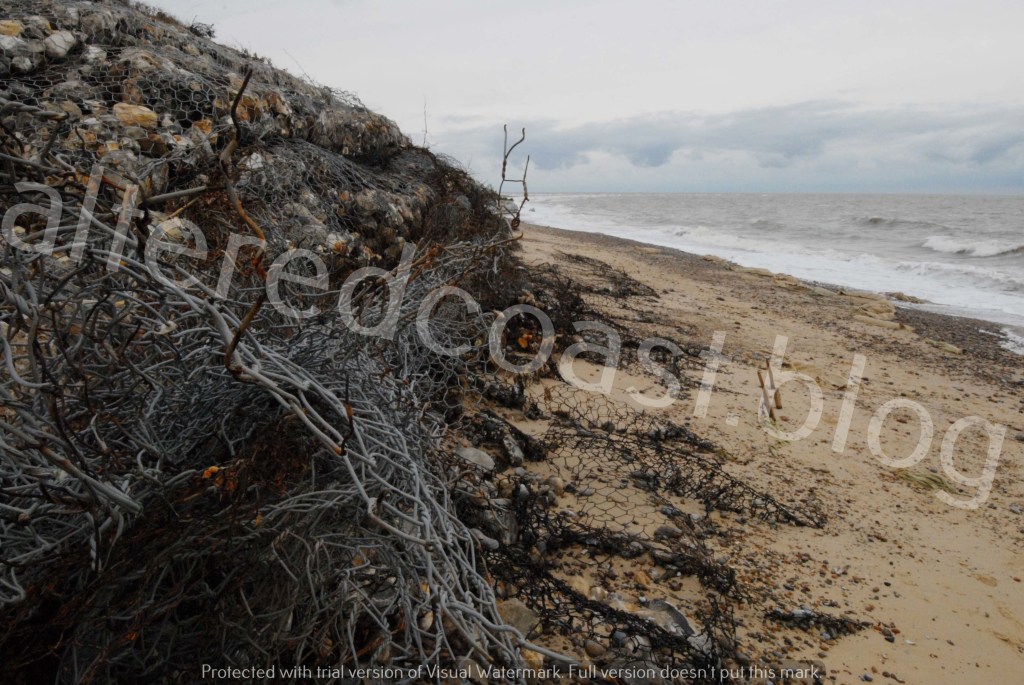
Stone Basket Gabions showing signs of wave damage on section south of scene of recent severe erosion. Thorpeness Beach, Suffolk, East Anglia, UK. 18th October 2025

5-Year Anniversary

Following recent high waves and strong winds on the East Anglian coast, it is perhaps appropriate to announce the 5-year anniversary of the blog Altered Coast and its previous incarnation Altered Marshes.

Hazlewood Marshes, an intertidal nature reserve owned by the Suffolk Wildlife Trust, next to the Alde and Ore Estuary. 20th September 2025

The original inclusion of the word marshes is due to a visit in 2020 to Hazlewood marshes, an intertidal reserve next to the Alde and Ore estuary, run by Suffolk Wildlife Trust. The experience of visiting Hazlewood and the reason for its present incarnation, prompted an interest to find out more and Altered Marshes was set up as means for these discussions.

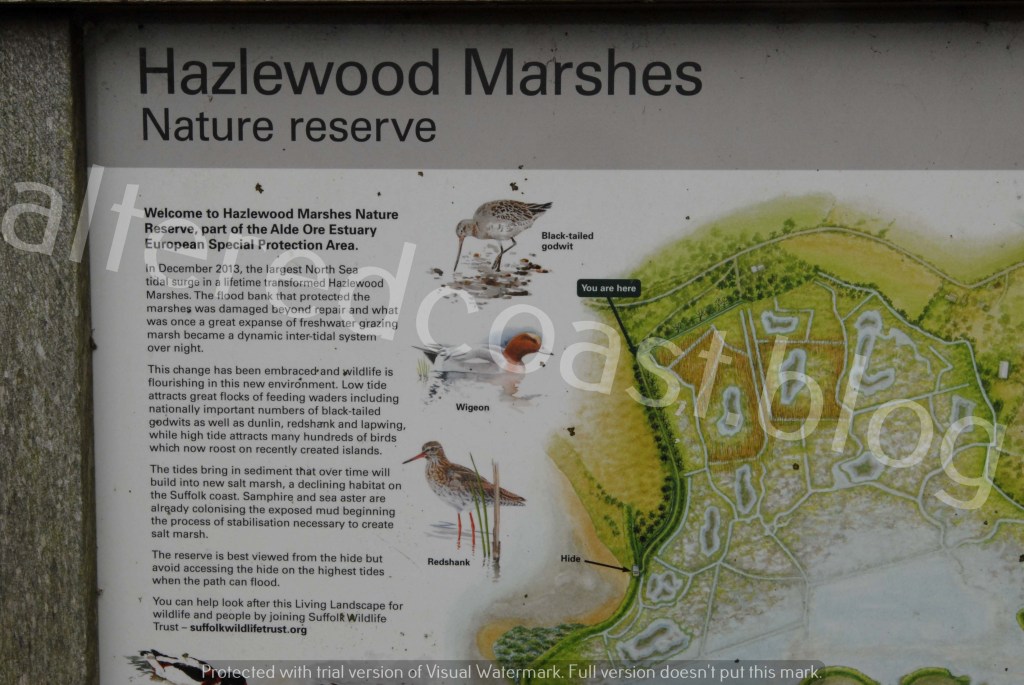
A information board at Hazlewood Marshes explaining the origins of the reserve explaining how it became intertidal in 2013. 20th September 2025.

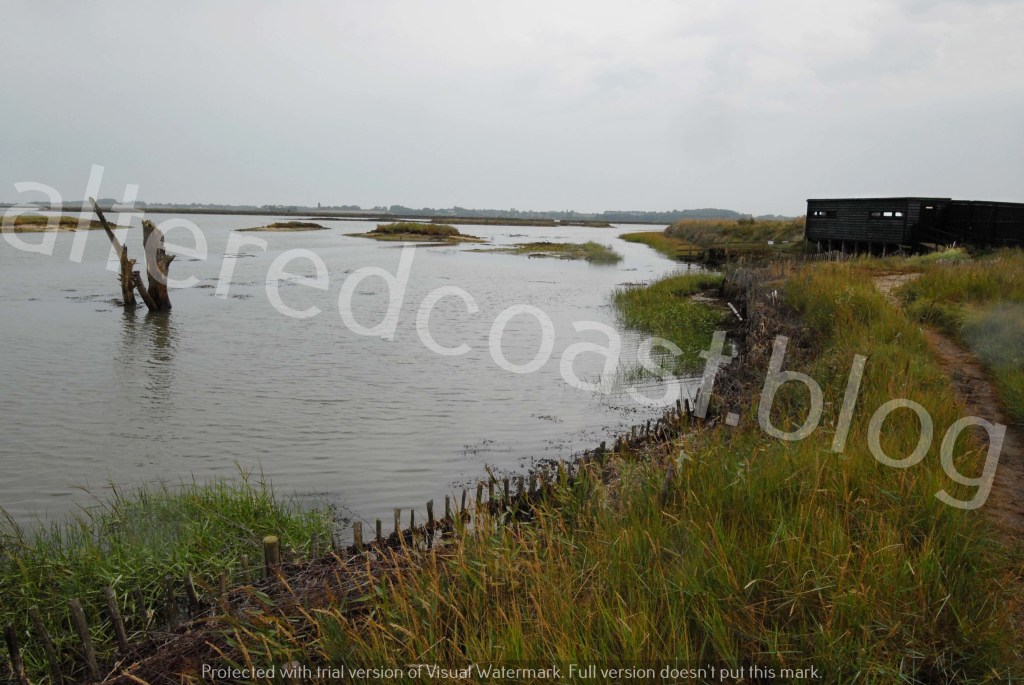
Hazlewood Marshes used to be a Fresh Water marsh, but became intertidal following a storm surge in 2013, which broke through the sea wall between the estuary and the marsh. The reserve is thriving now, but erosion continues, with work constantly needed to protect the path out to the Bird Hide, on the right-hand side of the reserve.

View looking towards the Bird Hide at Hazlewood Marshes, with work by Suffolk Wildlife Trust to install Brash to try and withstand the path erosion just visible above the fence line.

Altered Marshes started, therefore, to look at estuary systems and erosion around the Alde and Ore Estuary in Suffolk. However, the 1st Anniversary post in 2021, concluded by outlining a change in focus to look at the characteristics of tides in the estuary and the open sea. To consider how these elements can shape the areas under observation. Therefore, the progression to the open coast had begun and subsequently, the name changed to Altered Coast.

View looking towards Thorpeness from Aldeburgh Beach, Suffolk, East Anglia. April 2021

The first location observed on the open coast was Thorpeness, one of many dynamic vulnerable locations to be visited, which has subsequently included Pakefield, Covehithe and Hemsby. 

Section of broken road looking towards Hemsby Gap at Hemsby Beach, in Norfolk. 2024

Study of the exposed, fast eroding beach at Hemsby brought a focus on the influence of near-shore processes, and the morphology, (shape) such as sandbanks. As well as a study of the effects of high-energy waves on beach levels, and dune frontages. This is turn, introduced ideas around coastal geomorphology. An academic discipline that considers the profiles of coastal geographies and the systems that influence their form. In addition, the influence of near-shore features on waves and how wind and waves are both influenced by coastal profiles and can also shape and irrevocably change and re-work coastlines.

The intention of discussions going forward is to try and take a step back and as well as examining locations individually, to also look at erosion, sea states, morphology (shape) of coastlines, rainfall and flood defence in a bit more depth. In addition, as Altered Coast continues to observe and analyse coastal change, storms and sea states, the concept of Palimpsest will be considered again. To see features of coastal damage as signposts, information boards, to tell of what has happened, and to enable a learning about what has happened before.

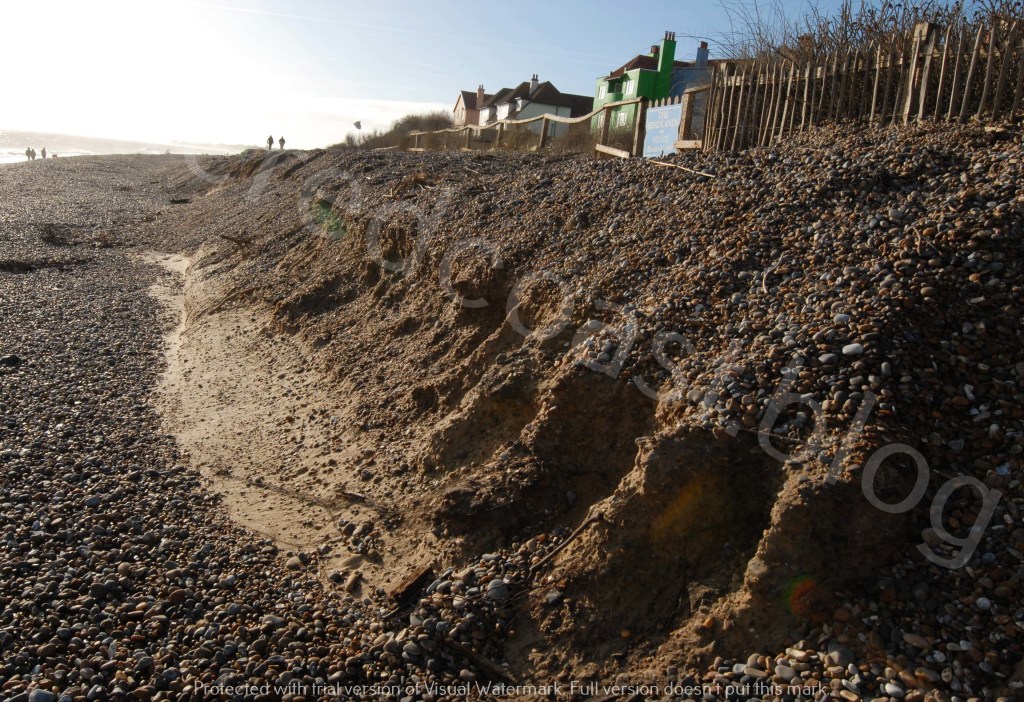
Recent erosion at Thorpeness Beach, seeming to reveal sections of cliff material laid down at the time of the Pleistocene. North End Avenue. Suffolk. 20th September 2025.

To also set discussions in an historical context, by looking at communities previously lost to the sea, such as Dunwich, to try and understand coastal erosion anew. To keep an awareness of the proximity of the East Anglian coast to Doggerland. An area of land between Europe and England, inundated at the end of the last ice age. Forcing communities that dwelled on the land to flee the rising seas. In a poem by Justina Hart called Doggerland Rising, Hart wishes to ask what our Mesolithic ancestors might whisper to us through the centuries if they could, about how we should interpret loss, re-working of coastlines and changing seas.

Severe Erosion at Thorpeness

A large ‘quarry like’ feature at Thorpeness Beach, created by severe erosion of Gabion Sea Defences. Thorpeness 9th August 2025.

Erosion at Thorpeness has accelerated dramatically with the creation of a quarry shaped section of beach, with around 7 metres of cliff retreat, replacing an area fronted by Gabions (Stone Baskets) backed by cliffs covered with vegetation.

For comparison, this is the same section of beach in 2023.

Section of Thorpeness Beach fronted by vegetated cliffs and Stone Gabions in 2023.

A number of homes on North End Avenue at Thorpeness are now at risk, with one home-owner being told, if the cliff retreats to within 5 metres of their home, it could be demolished.  

This section of beach has been very vulnerable to the strength of the waves for a number of years, with the stone-filled Gabions, frequently broken apart by the waves. Gabions are sea defences that are supposed to attenuate (lessen) the power of the waves.

Stone Gabion Flood Defences seeming to look as if they have been rolled up. Thorpeness Beach 9th August 2025

But frequently the shape of the damaged stone gabions seems to be mimic the shape of the Plunging Waves that so frequently weaken and smash apart the gabions.

Plunging wave breaking on Thorpeness Beach. 8th February 2025

A background to the severe erosion, which has occurred for a number of years at Thorpeness, is outlined in a discussion that looks at the interaction between waves and nearshore features such as the Sizewell Dunwich Sandbank System. To consider how such features can influence the erosion and the profile of the beach at Thorpeness. It has been said that around 2 metres has been eroded from the Sandbank system in recent years.

Erosion into fragile sandy cliffs is a well-documented phenomenon, with waves said to “collide” with the cliff surface, causing the rapid removal of sediment and the gouging of notches into the toe of the cliff. Transmitting damage both into and upwards within the cliff structure, causing retreat, sometimes metres inland from the original erosion.

An example of severe erosion at Truc Vet beach in France describes how once the cliff retreat occurs, the new retreat line remains. Even if beach levels accrete (accumulate) sediment in the summer, the profile and bones of the beach, remain weakened, remaining vulnerable to further change once storm waves return. Therefore, it could be said that it is not just the properties that are now at risk, but the whole structure of the beach and section of coast, which has been fundamentally altered and re-worked by the sea.

Solutions to the severe erosion at Thorpeness are not easy as both sections of beach, either side of the rock revetment, are subject to acute erosion.

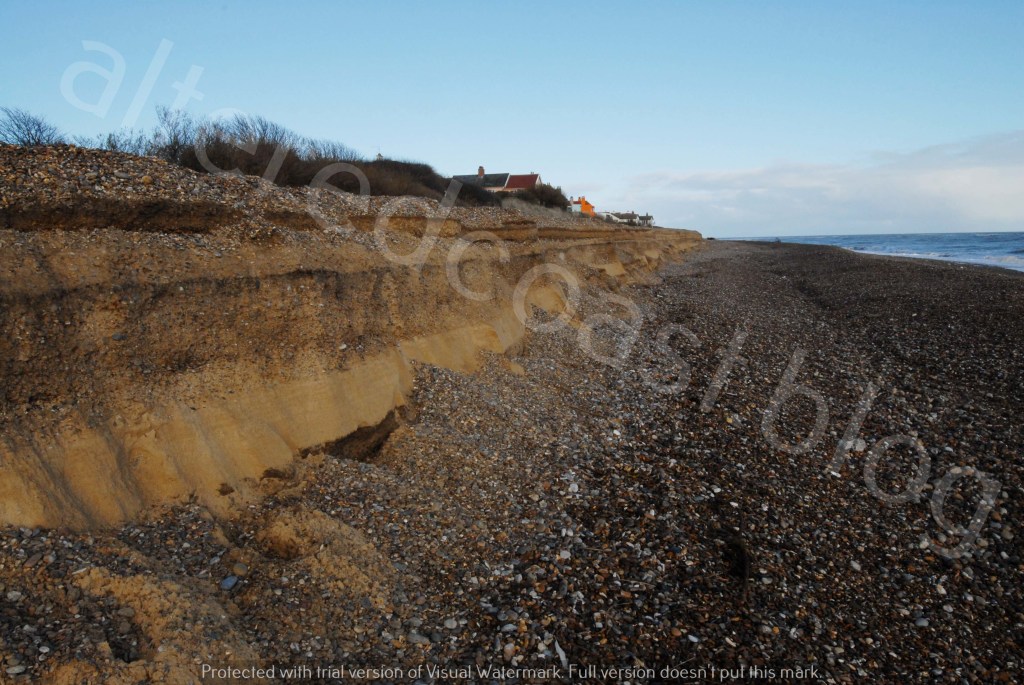
Recent erosion of Cliffs below the location of the demolished Red House, below North End Avenue, Thorpeness Beach. 3rd August 2025.

With a likely contributory factor being the tendency for waves, when they encounter an object, to ‘refract’ and cut around it into the cliff/gabions at either side.

Beach levels are also quite low on the foreshore below the Gabions, with no accretion (accumulation) of sediment, with a steep slope. Such features that can make it easier for waves to travel up the beach and directly hit the sea defences, as on this section of beach, there is very little distance between the sea and the defences.

Section of eroded cliff in newly created ‘Quarry-like’section, with remaining line of broken Gabions. Thorpeness Beach. 9th August 2025.

It is increasingly difficult to access the section of beach subject to severe cliff retreat, as even at low tide, it is frequently covered by sea water. Which obviously means this section of beach can constantly be shaped by the actions of the waves.

The television programme, The Secret Life of Waves, suggested that waves could be understood as moving bodies of energy, rather than sea water. At Thorpeness, the concerns of property owners at immediate risk and those in the wider area will be focused on the implications of the powerful energy of the waves. In the constant contention for possession between the sea and the land.

Newly created ‘Quarry-like’ section of Thorpeness Beach, with property nearby at risk from the severe erosion. 9th August 2025.

January Tide Data 2015 – 2025

What the sea would do, left to its own devices, was predictable, it would rise, then fall. What the wind would do, no man could tell.

Men of Dunwich. Rowland Parker.

Waves breaking on Aldeburgh Beach. 13th July 2025

Somewhat belatedly, is it is now July, this discussion will look at annual Maximum Observed Tide levels at Lowestoft Tide Gauge for three dates in the month of January. This discussion uses data provided by the British Oceanographic Data Centre. Examination of Maximum Observed Tidal data began in 2022, following an exceptionally high storm surge on 30th January 2022. Therefore 3 dates in January were chosen to enable a study over a reasonable period of time and view extreme sea levels in context. Through the collection of a random sample of data for the dates of 1st, 15th and 30th of January. Analysis of Tidal data has continued with 2025 marking 10 years of analysis of Maximum Observed Tidal data.

This discussion coincides with the recent release of the Met Office State of the Climate Report for 2024, which found from the start of the 20th Century, Sea Level Rise (SLR) increased by around 19.5 cm. Although the figure is qualified as data is obtained from a small number of tidal gauges, with data missing for some years, for certain gauges. A new tool was also launched recently by the Environment Agency to check risk of coastal erosion in the short, medium and long term, under different climate change scenarios.

It isn’t necessarily the intention to link observation of tide heights to SLR, particularly as each annual edition of the Met Office State of the Climate report states that provision of Maximum Tide Height data, simply shows values which is subject to annual and date specific variability. Whereas the 99th percentile method chosen, by the Met Office to measure SLR selects data from 1%, or 88 hours in a given year.

To look at 10 years of tide data, the chart below displays Observed Maximum Tide Heights for the 1st, 15th and 30th of January over the years 2015 – 2025.

Lowestoft Maximum Observed Tide Data 2015 – 2025

This discussion uses data provided by the British Oceanographic Data Centre

Lowestoft
CountryUK
Latitude of measuring point52° 28′ 22.8″ N
Longitude of measuring point01° 45′ 03.0″ E
OS grid ref. of measuring pointTM 5483 9273
Datum referenceAll data refer to Admiralty Chart Datum (ACD)
ACD = ODN -1.50m
Time referenceGMT (hours 00-23)

The chart displays the natural fluctuations of the tides over a 10-year period. with a small number of instances where tide heights appear more elevated. It has been found that with the exception of 2016, the four remaining instances of extreme maximum Tidal Heights seem to be clustered around the last four years of data collection, the years 2022 to 2025. Additionally, the average tide height observed in the ten years of tide height data from 2015 to 2025 is 2.72 m, which might be considered a high figure.

Waves breaking on Aldeburgh Beach. 13th July 2025.

But January is associated with increased likelihoods of stormy weather. For example, in 2025, on the 1st January, the Maximum Observed Tide height was 3.18 m at 10:00 pm, with a surge value 0.6 m. Indicating a deviation from the predicted tide height of 2.52 metres. Weather conditions for New Years Day included a Met office forecast for wind gusts of 48 mph earlier in the day, with wind gusts forecast to drop to 34/32 mph at 4-5pm, with a yellow wind warning in force. Conditions could be likely to generate a surge.

For the remaining maximum tide height values for January 2025, on 15th January the observed tide height was 2.82 metres, and on the 30th January the maximum observed tide height was 2.7 metres. Both of the tides on the 15th and 30th January were Spring Tides, with no notable weather systems to contribute to the elevated tide heights.

In 2016 a tide height of 3.1m was observed on 15th January and a tide height of 3.2 m was observed on 30th January, with surge values of 0.46 on 15th January and 0.72 on 30th January. On the 29th January 2016, a named storm Gertrude occurred, so this could have pushed sea levels above predicted heights.

Elevated Maximum Observed Tide heights for 2022 have been discussed separately and for 2023, there were no notable weather conditions that could have contributed to the high tide height of 3.01 m. The maximum observed tide height for the 15th January 2024 of 3.37 m occurred during exceptionally stormy weather. Noteworthy, as it was the second highest maximum observed tide height recorded over ten years of analysis.

Examination of ten years of tide height data from 2015 to 2025, provides a useful introduction to observations of tidal patterns. But the title of this consideration was a play on the concept that tide heights can be predicted but the effect of the weather can alter tidal behaviours. But tides are also complex, with many more elements which will be considered in future discussions. Such considerations could focus on future predictability, in an era of rising SLR and weather intensities and how such uncertainties might impact vulnerable coast locations.

Waves breaking on Aldeburgh Beach. 13th July 2025

The question is not what you look at, but what you see.

Henry David Thoreau, I to Myself, August 1851

Cliff top and Covehithe Beach, Benacre Nature Reserve

The coastline of Norfolk and Suffolk is bearing the scars of the winter storms of 2024-2025, and this discussion will consider a few examples of the attrition of heavy rain and wave action. Including large slippages of cliff material at Overstrand in Norfolk, with a recent announcement of plans to repair the sea wall. In Suffolk, large cracks were visible at Covehithe at Benacre Nature Reserve. In addition, north of Southwold pier, repairs to fill voids and replace slabs have taken place, following the collapse of sections of promenade. Plans have also been brought forward to repair the toe of the sea wall.

Consideration will be framed around two concepts. The first considers the ghostly image of Dunwich in a painting by Joseph MW Turner, an artistic representation of All Saints church and a reference to the village of Dunwich, that were both lost to the sea. The second concept asks that as churches, such as St Andrews at Covehithe, and communities edge ever closer to the sea. Could it be useful to see through the lens of what has occurred before, to try and interpret the storms of the present to learn anew erosion processes in era of climate change.

To begin by looking at slippage and cracking of cliff structures, it might be useful to consider each element and its impacts on the cliff. Wave action that initially acts at the base of the cliff and rainfall that falls on the cliff top but can seep inwards. Firstly, rainfall and Groundwater which can rise in periods of heavy rainfall, can impact on sediment, to enable one to cause a change in the other. The factor in the middle is shear strength and its ability to resist failures in the solidity of cliff sediment, determined by soil suction and pore water pressure.

Soil Suction describes when sediment becomes saturated, causing air to be lost from pockets in the soil to be replaced by water which in turn causes Pore Water Pressure. This process acts to apply stress due to the volume of water contained in pockets it occupies. This stress is positive if sediment is totally drenched, and pressure is manifold if water cannot increase in volume or flow away through alternative fissures. Pore water pressure can make sediment heavier and reduce its shear strength. The Cliff slippage at Overstrand is thought to be due to the slumping of sediment due to heavy rainfall, with water seen to be running down the cliff.

Concerning Wave action, the tension cracks at Covehithe could be caused by wave action at the bottom of the cliff gouging notches, which could cause slumping of material some metres above.

Tension Cracks visible in Cliff Top and inland of cliffs at Benacre Nature Reserve.

Significant sculpting of the cliff surface is also visible. Wave action can transmit volatility up through the cliff and this can create tension at the cliff top. Cracks in the cliff could also be caused by heavy rainfall or stress within overhanging section, due to undermining of cliff below.

Sculpting of cliff surface by wave action at Benacre Nature Reserve.

At Overstrand plans have recently been announced to repair sea wall, so this discussion will move on to briefly consider sea walls, as a means of sea defence.

A sea wall can be viewed as a fixed protective barrier, but as the interface between wave action and sea wall can be a dynamic, unforgiving environment, alterations and repairs are sometimes required.

Weaknesses visible in concrete in sea wall north of Southwold Pier. 25th October 2024.

Reflected wave energy can interact with incoming waves and generate seaward currents that can transport sediment offshore and remove it from the toe of the sea wall. This can undermine or break down sea wall structures.

Spray from waves rising up as waves rebounding from sea wall, interact with incoming waves. Southwold Sea Wall, Suffolk. 25th October 2024.

Additionally, waves can transmit energy along the frontage of sea walls, causing erosion at the terminus of hard sea defences.

Photo of beach in front of Southwold sea wall with signs of possible scouring of beach surface immediately below sea wall. Photo courtesy of Jonathan Hadgraft.

But it is also thought alterations to beaches around sea walls due to storms can be similar to beaches where sea walls are absent, though this depends on availability of sufficient volumes of sediment. Post storm revival can also be similar.

However, as work continues to repair and reinforce structures as storms intensify, it would seem it is a struggle to maintain what is solid and robust, like the slabs on the promenade. Or in undefended locations it is the difficulty to prevent loss of cohesion in cliff sediment causing further slippages and loss of land.

During the time the thriving village of Dunwich was lost, sea defences were scarce and forceful sea water was able to inundate coastal locations. Since these times, with engineering knowledge about hard defences, processes and behaviours relating to sea walls and cliffs were thought to be understood. But under Climate change, the sheer volume of rainfall and the intense power of storm waves, could generate more complex, stronger processes that generate feedback loops with consequences that are harder to control. Under Sea Level Rise deeper water could be present in front of sea walls, with the wave base also growing in depth. As transmission of energy alongside a sea wall, could generate more severe scour in front of sea walls and lower beach levels.

Looking through the lens of ghostly images of lost churches, although the power of the sea has always raged, perhaps it has now transformed into aggregated surplus strength. As increasing volumes of rainfall and forceful wave action, act against soft, erodible cliffs, altering adaption and repair mechanisms. Especially as extreme dry periods can also weaken cliff structures causing desiccated cracking. It could be the combination of excessive dry periods, combined with extreme rainfall and high-energy waves that cause more frequent failures.

Academic articles and a recent television programme on the secret lives of waves, state that it isn’t water that moves but energy that transmits from wind and atmospheric pressures to the sea surface. When considering that it isn’t a question of what you look at, but what you see, perhaps it is the ever active, internal and external working of the aggregated surplus strength of rainfall and energy. Weakening, pounding and altering that what was thought to be solid. Just like the raging storm seas washed away the once bustling key trading port of Dunwich.

Pakefield

A tropical tree that has fallen from a garden above with eroded cliff in background. Pakefield Beach 26th October 2024

Pakefield Beach is a fascinating example of erosion and deposition of sediment. With a dramatic contrast between substantial accretion (build-up) of sand at Benacre Ness, with the assessment that this feature seems to be building up to the north, whilst eroding at its Southern end. The build-up of Benacre Ness could help protect Pakefield, but at the current rate of growth, the timescale for this protection, looks to be in around 7-8 years’ time.

Expanse of sand accumulated at Benacre Ness, south of Pakefield Beach. Photo taken 26th October 2024.

Whilst, despite local accumulations, very little sediment is retained on the beach between Pontins Holiday Park and where fishing boats are moored. The fishing boats are pulled up to a higher level of beach, as the foreshore is steeply sloping and appears stripped of sediment. A lowered profile such as this can make it easier for powerful waves to sweep up the beach, potentially making locations more vulnerable to storms. Like a powerful surge on Friday 24th November 2023, when a large section of Access Road collapsed at Pakefield.

Pakefield Beach looking North. Photo taken 26th October 2024.

However, erosion at Pakefield, can be caused by sea and rainfall, as both can cause alteration and failure. To look these points in a bit more detail, this discussion will consider the concept of the aggregated surplus strength of precipitation and wave action and consider what this means for the beach profile and the coastal community.

Waves breaking on Pakefield Beach. 29th March 2024

Looking at the aggregated surplus strength could mean analysing the cumulative effects of storms and rainfall to assess the force in each element and how this could contribute to the gradual weakening and break down of a cliff frontage.  

Cliff eroded by Rain fall and wave action. Pakefield Beach. Photo taken 26th October 2024.

Firstly, the effects of rainfall will be considered looking at an approach known as Seepage Erosion. This process refers to the flow of water once it enters a cliff face, possibly through a tension crack, the water flow can exert strength to initially form a watercourse with bonding of sediment sustaining the structure for a period of time. However, if water flow is subject to a level of agitation, this can concentrate erosion to gouge indentations, causing roofs of watercourses to eventually fail to form gorges or basins.

It is thought where channels are more intricately and extensively integrated into the cliff face, the greater the level of water required for Seepage Erosion. However, it is also thought network of watercourses can be complex and localised and structures so refined, it is hard to envisage their onward progression. This could make estimating possible forces at work and extents of potential failure hard to assess.

However, while these processes describe the physical mechanisms at work within the cliff face, at another point on the beach, gullies can be seen running down the front of the cliff face. It is also possible that such channels and gullies could widen over time, possibly eroding back into the cliff, causing failure, due to the application of stresses in the body of the cliff. Such processes could cause landslides or blocks of material to fall from the cliff.

Gullies thought to be formed by rainwater, on cliff frontage at Pakefield. Photo taken on 26th October 2024.

Another powerful element working away at the cliffs is of course wave action. On beaches with very little sediment coverage to dissipate energy, it is possible to see features that testify to likely forces at work.

Erosion feature thought to be Megacusp Embayment. Pakefield Beach. Photo taken 26th October 2024.

One visible feature is sometimes referred to as a Megacusp Embayment. Factors that lead to their formation include varying sediment types, foreshore profiles and wave approach producing differing wave patterns. Such wave run-ups when interacting with the cliff face, alternately erode and deposit sediment, creating erosion “embayments” and “horns”.

It is thought several complex wave forms can create these features, but a basic summary could state that high waves with rapid occurring regularity, could act to mix sediment in the Swash zone as the wave flows up the beach and lower waves with slower regularity could possess reach to “collide” with the cliff face. Thereby loosening sediment and enabling mechanisms with a strengthening back wash to rapidly transport sediment off the beach.

Signs of wave action cutting into cliff face. Pakefield Beach. Photo taken 26th October 2024.

Such processes can also cut into the cliff face, steepening and eroding the entire frontage. It is also thought such regimes can transfer sand to offshore bars, and there are considerably large sand bars in the vicinity of Pakefield beach.

Sand Bars off Pakefield Beach. Photo courtesy of Pakefield Coastwatch.

In conclusion, the cliff face and beach at Pakefield continue to be vulnerable. Winds from a South Easterly or Northeast direction can keep sea water up on the beach. Equally beach levels are estimated to be around 2 metres lower. Pakefield Coastwatch, a coastal watch station manned by volunteer men and women, have recently begun to warn of high tide around 3 ½ hours before it is due, presumably because the tides come in quicker due to lower beach levels.  Further falls of old beach road continue with old caravan bases, extending over a metre out from the cliff tops. It is thought erosion is shifting South to North, with erosion of base of beach steps evident.

Empty plot where home once stood. Cliff top at Pakefield Beach. Photo taken 26th October 2024.

Walking on the access road on the cliff top, empty plots act as empty reminders to those with properties and lives still to be lived on the landward side of the road. Testament to the unpredictable aggregated surplus strength of forces this eroding and stripping away this fragile coastline.

Sudbourne Beach – Fragile Sediment

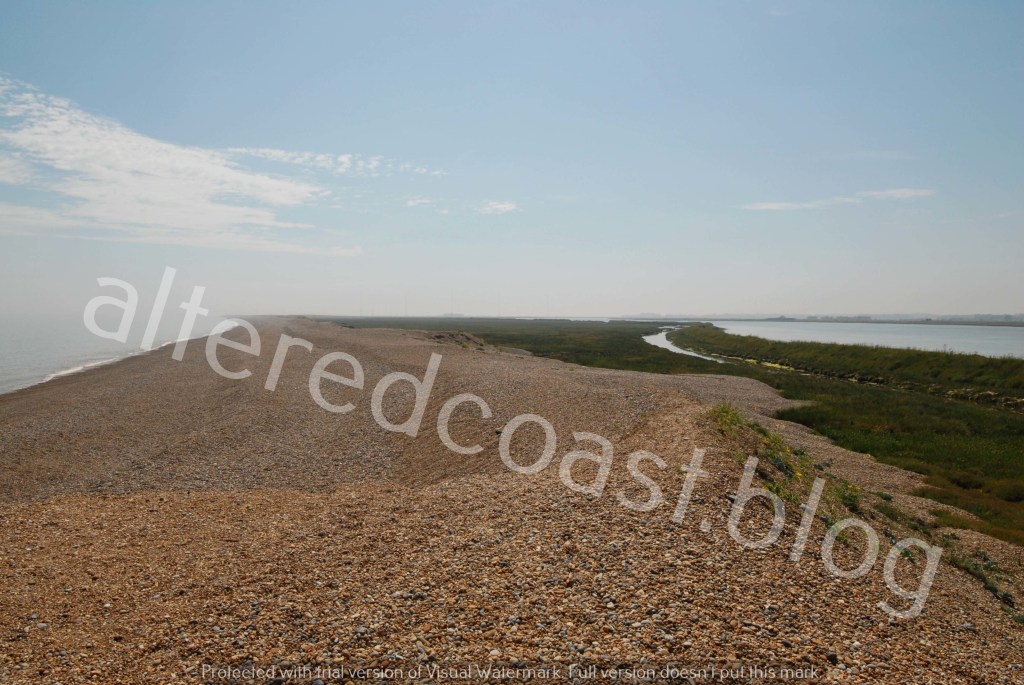
View of North Sea from top of Shingle Ridge fronted by Concrete Mattress, Rock Revetment and Concrete Block Sea Defences. Sudbourne Beach 13th October 2024.

This discussion will update previous observations of Sudbourne Beach, near Aldeburgh, in Suffolk, in the United Kingdom. The update will consider the Saltmarsh and channel that run along the edge of the Shingle fan overwash, that formed around Autumn 2023. As well as briefly discuss the overall form of the beach system and erosion of the shingle ridge fronted by hard sea defences.

Firstly, the previous discussion to consider Sudbourne Beach, thought it might be possible for vegetation to begin to grow on top of the large Shingle Fan Overwash. It would appear this is beginning to happen. It is thought shingle washover fans can evolve to function as a base for new Saltmarsh to grow. As essentially Saltmarsh develops from the formation of an elevated reasonably solid accumulations of sediment.

Vegetation growing on top of Shingle Overwash Fan adjacent to Channel running through Saltmarsh. Sudbourne Beach 13th October 2024.

But the appearance of the Saltmarsh and the Channel that runs along the edge of the shingle fan, seems to have altered with the saltmarsh seeming to look thinner, and with the channel looking like it has widened. It is thought that channels can be the main conduits for movement of sediment within saltmarsh systems. As it is hoped Saltmarsh landforms can increase in height above the regular flow of tidal water, to create a cohesive mass of vegetation sufficient to attenuate (lessen) wave energy.

In established saltmarsh systems, sinuous channels that intersect marshes can facilitate alterations in the flow of water, such that sediment held in suspension moves swiftly through the channels, whilst sediment at times of high water can be deposited when flows run over Saltmarsh. Accumulation of sediment on top of saltmarsh can encourage its growth and also aid the formation of deep channels. Similarly, it is thought Neap tides can flow within the channels and deposit sediment, whereas Spring Tides can erode the channel system, causing them to widen as well as deposit sediment onto the marsh surface.

It would seem the saltmarsh system adjacent to the shingle washover fan at Sudbourne Beach, is out of equilibrium as it would appear to lack cohesion. Rather than a dry elevated saltmarsh system, with channels winding through, saltmarsh appears to contain a substantial amount of tidal water within it. There is also a clear Tide Line seeming to show a meeting of estuary and Sea water.

Tide Line showing deposits of estuary reeds and seaweed on Shingle Overwash Fan adjacent to Saltmarsh Channel. Sudbourne Beach 13th October 2024.

It is not clear why the alteration to the saltmarsh system has occurred. Linked to this, it is interesting to observe that within the channel at the edge of the shingle fan, in addition to shingle, their appeared to be a layer of sand in the channel. It is thought that due to low-energy conditions more prevalent in saltmarsh systems, the predominant sediment type would be silt, clay or mud. The presence of sand could indicate higher energy tidal flows.

Edge of Shingle Overwash Fan and Channel running through Saltmarsh, with a layer of sand visible in the channel. Sudbourne Beach 13th October 2024.

It is a puzzle however, as it is commonly thought that during a storm event, sand being a finer sediment, is transported offshore, perhaps to a nearshore sand bar. With courser sediment such as shingle moved as bedload, to be deposited further up the beach or as overwash if sufficient energy is present.

This moves the discussion to observations of the beach system itself. It is said that shingle beaches have a narrow Surf Zone, therefore the majority of sediment movement and influence of waves on the beach occurs in the zone where waves wash up (Swash) and move back down the beach, (Backwash). The succession of shingle ridges on the beach, reflects the reach of the Swash during Neap and Spring tides. With a tide line just visible towards the back ridge of the beach suggesting the presence of recent high water.

View of remains of shingle beach crest and shingle Overwash and beach profile at Sudbourne Beach 13th October 2024.

It would also appear the slope of the beach is reasonably steep; this could align with the description of shingle coastal locations having Reflective profiles. This can mean very little energy is lost when waves break on shingle beaches, so energy is transmitted and is shaped by the profile and sediment make-up of the beach itself.

Regarding the shingle fan itself, it could fit the description of a sluicing overwash, where substantial failure of the beach crest has occurred, but the overall height of the back beach and shingle fan has not substantially changed. Though this location is a dynamic environment, and it rarely stays stable for long.

This is also especially true of the section of remaining shingle ridge fronted by hard sea defences. The ridge certainly seems to have an airy feel as erosion continues.

View from top of Shingle Ridge with hard defences and the North Sea to the left and saltmarsh and estuary to the left. Sudbourne Beach 13th October 2024

It is also noticeable how erosion is especially concentrated around the back of the Groynes. Sea defences such as these are designed to trap and retain sediment. It is thought that in some circumstances, rip currents can form around Groyne structures, with approaching waves interacting with waves leaving the beach. This can generate rotating currents with powerful alongshore currents forming in both directions. Such rip/circular currents can facilitate the rapid removal of sediment.

Erosion into Shingle Ridge behind Timber Groynes. Sudbourne Beach 13th October 2024.

In conclusion, ongoing changes observed at Sudbourne Beach can be summarised as a contrasting picture. With settlement of vegetation on the shingle fan, whilst processes that formed the shingle overwash, play out to a lesser extent around it.

The beach profile indicates the evolving shifting of shingle as if energy transmitted from wave action is constantly kneading away to erode and rework. As elements thought to be firm structures, beach, ridge and salt marsh, instead serve as dynamic fluid symbols of the fragility of this coastal location.

Sudbourne Beach – Shifting Shingle

Sudbourne Beach, Suffolk. 19th July 2024

This discussion will consider observations of Sudbourne Beach over the period July 2023 to July 2024. Three points to be considered include alteration to the Morphology (shape) of the Shingle Ridge. The nature of the apparent relationship between the Shingle, Saltmarsh and Tidal water from the Alde & Ore estuary. In addition to the state of the Shingle Ridge protected by defences.

Regarding changes in the morphology of the Shingle Ridge, a photo taken in July 2023, shows the ridge largely intact, with a throat feature. This indicates that a small Overwash could have occurred, which could have pushed a small fan of shingle onto saltmarsh behind Sudbourne Beach.

Sudbourne Beach. Suffolk. 2nd July 2023

Within a period of four months, a process of more extensive Overwash seems to have occurred.

Sudbourne Beach. Suffolk. 5th November 2023

With a further extension of the shingle fan visible a few weeks later.

Sudbourne Beach. Suffolk. 26th November 2023

The process of Overwashing can occur when wave action, possibly strengthened by storm surges extends over and behind the crest of a shingle ridge. It is not necessarily the height of sea water present, but the fact that waves possess the strength to reach over the top of the ridge and leave sediment in the form of a shingle fan behind the original location of the beach ridge. Instances of Overwashing are distinct from Overtopping, which can involve waves reaching the top of the ridge and leaving shingle, enabling it to accrete (build-up) sediment.

The term Inundation is also used to describe the conditions which cause sea water to sweep shingle down from a ridge. However, as observations of the conditions that caused the alteration of the ridge are not available, Inundation seems rather a blunt, general term, that doesn’t relate more specifically to the situation. It is useful to be aware however, that observations of the wide Overwash of shingle, followed a particularly stormy period, which saw Storm Babet and a very powerful storm surge on November 24th, which caused damage right along the Norfolk and Suffolk coast.

This moves the discussion on to the current relationship between the shingle fan and water from the estuary and at times the sea and the saltmarsh. It would appear there is a regular tide line, which indicates the level of water present, which it is supposed mainly originates from the Alde & Ore estuary. It is supposed water travels up the channel that runs behind the earthen flood defence, that separated the saltmarsh from the Alde & Ore estuary.

Sudbourne Beach. Suffolk. Edge of Overwash Shingle Fan. 17th-18th February 2024

It is also possible to observe a channel of water that runs through the saltmarsh from the main channel behind the flood defence and appears to run in front of the edge of the shingle fan. Additionally, it is possible to wonder if scouring of sea water sometimes occurs into the saltmarsh, at the edge of the Shingle Fan.

However, forceful sea water as it slows down, having flowed down the back of a shingle ridge, can let go of the sediment (shingle) it is holding as bedload and lay it down as a sediment fan. The occurrence of scouring or the placing down of sediment, relate to the likely levels of velocity in sea water, once it Overwashes the shingle ridge.

More recent observations also show colonisation of the edges of the pools or channel by saltmarsh, with a more established channel running along the edge of the shingle.

Edge of Shingle Fan. Sudbourne Beach. Suffolk. 19th July 2024

The third point to be considered is the shingle ridge that is protected by flood defences. Methods of protection used, include Cement Mattresses, Rock Revetments and Groynes, but despite the substantial hard defences, in certain sea states, wave action still reaches the top of the ridge. With scouring visible into the shingle ridge behind the defences.

Scouring into Shingle Ridge, behind Concrete Mattress and Rock Revetment Flood Defences. Sudbourne Beach. Suffolk. 19th July 2024.

In certain locations, cliffing has occurred, as the ridge of shingle has been eroded. It is thought for such features to form, a certain amount of sand is required to provide the necessary cohesion for the cliff to hold its vertical form. The Shingle Ridge protected by defences is still holding its rigidity but is still vulnerable to wave action. This shows the dilemma with defences or natural beach ridges, as even with protection, the ridge is gradually becoming narrower due to wave action erosion.

Formation of a vertical shingle cliff due to erosion of shingle ridge behind rock revetment defences. Sudbourne Beach. Suffolk. 19th July 2024.

Regarding the future of Sudbourne Beach, it could be a question of how the relationship between Saltmarsh, Sediment and the Shingle Fan evolve. If the Saltmarsh is covered frequently with tidal water, this could deposit sediment which could build up the Saltmarsh. Equally, vegetation could begin to colonise the shingle fan, indicating a degree of stability. Additionally, it would seem useful to consider how the shingle fan settles on top of the Saltmarsh and whether this process, lowers or heightens the shingle fan over time.

Edge of Shingle Fan, with tide line of estuary and occasionally sea water. Sudbourne Beach. Suffolk. 19th July 2024

Related to this, is the development of the slope of the shingle fan that extends down from the backshore of the beach. This could influence the frequency with which waves can travel over the fan from the open coast. As it is perhaps the future behaviour of sea water that extends down the shingle fan, and tidal flows that travels up the estuary that could determine the future of Sudbourne Beach.

Storms that Swell The Sea

Slaughden, Aldeburgh, Suffolk, 21st April 2024

A few brief comments on High Sea levels that have been recorded on the East Anglian and Essex Coast, with Flood Alerts issued for a number of days in a row for Essex, Suffolk and Norfolk. The chart below from the British Oceanography Data Centre shows the Observed High Water levels comprised of tide heights and small surge levels for Lowestoft for the dates of 17th-23rd August.

Chart sourced from British Oceanographic Data Centre showing Unprocessed data for 17-23 August 2024, showing Tide Levels and Observed High Water. Data from the National Tidal and Sea Level Facility, provided by the British Oceanographic Data Centre and funded by the Environment Agency.’

Elevated sea levels saw two different sea states, with noticeable high sea levels, but low wave heights over the period of Tuesday 20th and Wednesday 21st August. With higher wave levels beginning to show on the evening of Thursday 22nd going into Friday 23rd August, Both Sea states pose challenges, as high volumes of water can inundate coastal locations, like the Mersea Strood, which has been frequently underwater in recent days. Additionally, estuary islands like the RSPB nature reserve at Havergate Island, have seen the island cut in half, due to a surge into spillways designed to absorb brief floods of sea water. Video courtesy of RSPB volunteer Steve Everett.

Higher sea levels occurred at a time of Spring Tides alongside a Supermoon. However, two particular storms, the remnants of Ex-Hurricane Ernesto and the 12th named storm of the season, Storm Lillian hit the UK particularly hard. The chart below shows the Ex-Hurricane Ernesto to the west of the UK, on Tuesday 20th of August.

According to the Met Office, a weather pattern moving into Wednesday and Thursday saw the Jet Stream absorb a weather system which shifted onto the cold side of Jet Stream. It was suggested this could rotate into a more dynamic feature into the early hours of Friday 23rd August. This system could have developed into Storm Lillian.

From sea state measures like the Shipping Forecast and monitoring data, from Felixstowe in Suffolk and Happisburgh in Norfolk, it seems Storm Lillian was a much more intense powerful storm. Particularly as it moved into the North Sea during the morning of Friday 23rd of August, before clearing into Scandinavia. The map below shows areas of the UK, subject to 8-11 Gale Force winds for the period of 10:00 am on Thursday 22nd August-10:00 am Friday 23rd August 2024.

Image courtesy of https://www.metoffice.gov.uk/weather/specialist-forecasts/coast-and-sea/shipping-forecast

The video from the Met Office below explains about the arrival of Storm Lillian, and shows the storm moving into the North Sea, and around 1 minute in the video shows wind speeds over the northern North Sea of around 60-70 gusts per hour.

Video courtesy of The Met Office

Data from National Coastal Monitoring list the Surface Pressure Measures and wind speeds for Felixstowe and Happisburgh for Friday 23rd August 2024. For both areas, the deepest measures of Low Pressure occurred in the early hours of Friday 23rd August. At Happisburgh, Low Pressure (LP) dipped to 999 mb at 1:10 am with wind gust speeds of 18.1 Knotts. LP fell further to 995 mb at 04:30 am with wind gust speeds of 26. 8 knotts. Eventually returning to 999 mb at 09:40 am with wind gust speeds at 28.6 knotts. At 07:20 am, with LP at 995 mb, wind gusts speeds reached 32.7 knotts.

At Felixstowe, the period of Low Pressure was briefer, with LP falling to 999 mb at 02:00 am with wind gusts speeds of 25.1 knotts. LP dipped further to 997 mb at 03:50 am with wind speed gusts of 37.3 knotts. Eventually returning to 999 mb at 08:50 am with wind speed gusts of 41.3 knotts. Wind gusts reached their maximum at 06:00 am, measuring 41.9 knotts, with LP at 997. Data courtesy of the National Network of Regional Coastal Monitoring Programmes of England

Interestingly, the areas that saw the most noticeable, albeit small surges on Friday 23rd of August were Harwich and Sheerness, measuring stations both placed in the Southern North Sea, just down the coast from Felixstowe. Data recorded by the British Oceanography Centre.

Chart for Sheerness.

Chart sourced from British Oceanographic Data Centre showing Unprocessed data for 17-23rd August 2024, showing Tide Levels and High Water. Data from the National Tidal and Sea Level Facility, provided by the British Oceanographic Data Centre and funded by the Environment Agency.

Chart for Harwich

Chart sourced from British Oceanographic Data Centre showing Unprocessed data for 17-23rd August 2024, showing Tide Levels and Observed High Water. Data from the National Tidal and Sea Level Facility, provided by the British Oceanographic Data Centre and funded by the Environment Agency.’

Discussion of the intensity of a storm can be useful as it enables a consideration of the force likely to be transmitted to the body and surface of the sea. This in turn relates to the ability of High Wave Sea states to shift large amounts of sediment. Agitated sea states can also contain more force, which can cause more damage and be harder to contain. However, during the week of 19th-24th of August 2024, it has been the Total Water Level that has been a significant problem to manage.

Previous discussions on AlteredCoast, have considered whether it is the big storm events or incremental erosion episodes that can be more destructive. But events over the last week have shown the vulnerability and the volatility of the interface between land and sea. Open as it is to the rise and fall of the ocean and the winds whipped up by storms that swell the sea

Storm Water

Wave breaking at Pakefield, Suffolk. 29th March 2024

This discussion will continue looking at the concept of Total Water Level by taking an annual look at observed high water levels for the 1st, 15th and 30th January for the years, 2015-2024.

As the data from January 2024 coincided with a period of intense stormy weather, this discussion will look at features of sea states in stormy conditions. As a framework for this discussion, a period of five days from 22nd-26th January, will be considered, when Storm Isha and Jocelyn followed each other in quick succession. Over five days, 3 Surges were recorded at Lowestoft, measuring at least 1 metre in height with significant negative surges also occurring.

The data was collected by the British Oceanographic Data Centre and the data is sourced from the National Tidal and Sea Level Facility, provided by the British Oceanographic Data Centre and funded by the Environment Agency. The data is obtained from Port P024 at Lowestoft in the county of Suffolk, in the United Kingdom.

This discussion will consider the formation of positive and negative surges in relation to the intensity of the dialogue between wind, sea and low pressure. These elements will be assessed, to begin an ongoing consideration of whether they indicate the possible energy levels, that could be thrown against a coastline, during a storm.

Firstly, to look at annual Tidal data of Observed High Water levels from 2015-2024, collected for 3 dates, the 1st, 15th and 30th of January.

The data was collected by the British Oceanographic Data Centre and the data is sourced from the National Tidal and Sea Level Facility, provided by the British Oceanographic Data Centre and funded by the Environment Agency. The data is obtained from Port P024 at Lowestoft in the county of Suffolk, in the United Kingdom.

One noticeable value is the figure for Observed High Water for 15th January 2024. This the second highest value for OHW for the dates and years studied. However, the data should be qualified, as the value was recorded at midnight on January 15th, which was half an hour after High Tide on January 14th. It should also be noted that Sunday 14th January was a Spring Tide. The Surge that was recorded for January 14th, which appeared to persist for 3 Tidal Cycles, has been considered in earlier discussions about Storm Surges.

Looking now at the week of January 21st-26th, focus will be given to the Surges on Monday 22nd and Wednesday 24th January. The start of the week, which was a Neap Tide on Sunday 21st January, was dominated with the arrival of Storm Isha. The images below give an indication of sea state and weather pressure systems in the hours before Monday 22nd January.

Firstly, the Shipping Forecast for the Thames area.

Secondly, the UK Met Office Surface Pressure forecast for midnight on Monday 22nd January 2024.

It should be acknowledged that Storm Isha was a particularly intense, powerful event, so should be seen as an extreme example outside of the usual occurrences of surge incidents during Neap tides. In terms of sea state conditions, the table below, gives a snapshot of the main values that suggest the conditions present in the Southern North Sea. Values were recorded at Lowestoft and Happisburgh on Sunday 21st January and Monday 22nd January 2024.

Data sourced from the National Network of Regional Coastal Monitoring Programmes of England.

These values indicate the individual conditions present at specific points, but it is also worth noting the duration of intense storm conditions. At Happisburgh, Low Pressure dipped to 999 mb at 7:50 pm on Sunday 21st January, and remained below 1000 mb until 08:20 am on Monday 22nd January. Wind gust speeds rose to 47.1 knotts at 17:50 pm on Sunday 21st January and gust speeds of over 40-50 knotts continued until 2:10 am on Monday 22nd January. It could be inferred that the wind speeds, and deepening of low pressure, hint at energy levels capable of creating the high values for SWH and Wave Power.

However, wind speeds and wave heights were much lower in the lead up to the largest surge of the week on Wednesday 24th of January, when Storm Jocelyn hit the UK. A surge of 1.215 metres was recorded at Lowestoft at 16:30 pm. The two images below for Tuesday 23rd January, give an indication of the storm conditions present. The first image shows the Shipping Forecast for the Thames area

and the UK Met Office Surface Pressure forecast for midnight on Wednesday 24th January.

The second image shows charts for Wind speed and direction the week of 20th-27th January 2024, recorded at Happisburgh, up the coast in Norfolk. One of the interesting aspects of the charts is the change in wind direction and drop in Wind speed, in the early hours of Tuesday 23rd January. Followed by a change in direction and increase in wind speed around midnight on the 23rd/24th January 2024.

Perhaps related to this is the sizable negative surge and subsequent large return surge on January 24th 2024. It is thought that a negative surge and subsequent Peak surge can follow the trajectory of the centre of a storm over a coastline. A time lag is also said to exist between negative and positive surge levels in storm conditions. In a study of surges at Immingham between 1930 and 1938, it was found a time difference of around 18 hours appeared between the highest and lowest level of a surge. On Wednesday January 24th, the lowest observed sea level at Lowestoft was 0.157 metres at 2:30 am, and the height of the surge was recorded as 1.215 metres at 16:30 pm. A time period of 16 hours.

In conclusion, it could be said both surges suggest different examples of energy levels. On the 22nd January, it is the intense ferocity of conditions, that could have contributed to the surge of 1 metre. On Wednesday 24th January, it is the energy present in the system capable of generating a return peak storm surge of 1 m +, following a significant negative surge.

Even after the main Winter storm season subsided, intense local storms continue on the Suffolk coast. Future discussions will consider characteristics of the forceful dispute between meteorological and sea state conditions and the energy they produce. To assess how this altercation transmits to shift sediment and alter beach morphology on the coastline.

Slaughden, Aldeburgh. Suffolk. 21st April 2024