Lowestoft High Tides 2015 – 2022

On 29th January 2022 a weather system, named by the Danish Meteorological Institute as Storm Malik, brought significant winds to the UK. The storm passed to the North-East of the UK and generated a large storm surge on 30th January 2022, which travelled down the east coast and had considerable impact at several locations on the East Anglian coast.

The surge occurred on a Neap Tide but it still raised sea levels at Cromer in (Norfolk) to the highest elevation recorded for 2022, with a Skew Surge of 1.4 m recorded. Similarly, at Lowestoft a skew surge of 1.3 m was logged. Furthermore, the storm surge travelled up the River Waveney from Great Yarmouth causing severe damage at Haddiscoe cut railway embankment and Carlton Marshes.

Additionally, at Slaughden, Aldeburgh in Suffolk, the surge arrived at the Alde and Ore Estuary around two hours before the usual High Tide. At Slaughden, there is a fairly narrow strip of shingle and compacted tarmac and track in-between the open coast and the Alde and Ore Estuary. Several boat yards and the Aldeburgh Yacht Club have premises at Slaughden that face out onto the Alde and Ore Estuary.

On 30th January 2022, high water was observed to be almost at the top of the sea wall on the estuary side and the open coast at Slaughden at the same time. Usually, the tide on the open coast would ebb away around 2 hours before High Tide is due on the Alde and Ore Estuary. High water remained at the same level at the top of the sea wall on both river and open coast for around 2 hours, before it ebbed as it would normally on the Alde and Ore estuary. On the open coast, at times the sea was estimated to be near the highest level observed to date on the beach side at Slaughden.

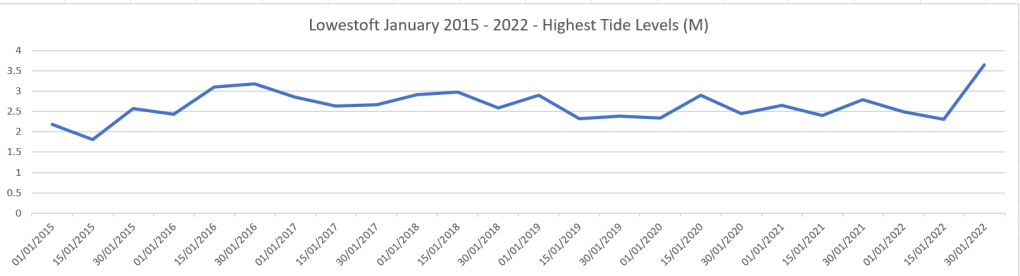
To consider the question of observed high water levels in more detail, it was decided to study data for three specific dates, the 1st, 15th and 30th for the month of January 2015-2022. Data was obtained from the British Oceanography Data Centre, from the Port, P024 at the site of Lowestoft, with the Latitude of 52.47300 and Longitude of 1.75083 with the start date of 01JAN2015-00.00.00 and end date of 23:45:00 for each year analysed. For data analysed in July, the start date was 2015/07/01 00:00:00 and the end time was 23:45:00 for each year analysed. The Contributor was the National Oceanography Centre; Liverpool and the data refers to Admiralty Chart Datum (ACD).

Data showing the maximum observed tide level for the dates of 1st, 15th and 30th for the time period of January 1st 2015 to 30th January 2022 can be seen displayed in the chart below.

Chart showing Maximum Wave Heights at Lowestoft for 2015 – 2022. Data from British Oceanographic Data Centre

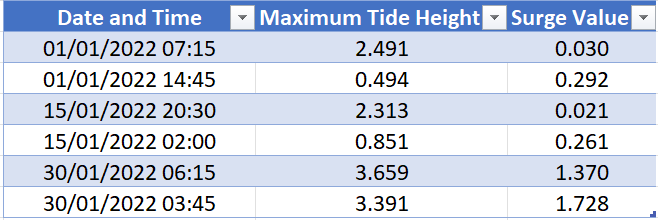
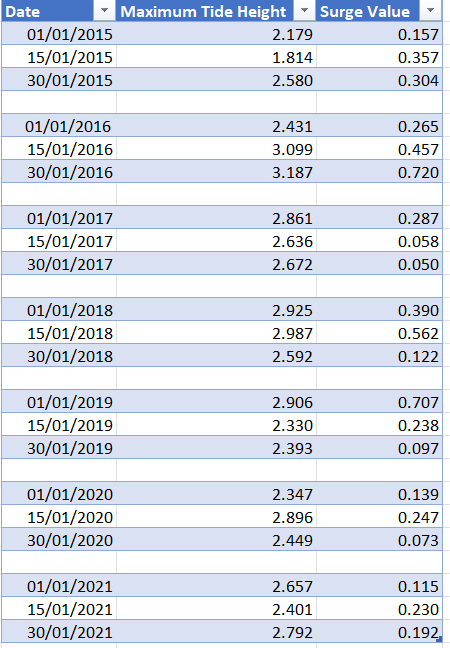
However, to get a better perspective, on the significance of each observed tide height, it is possible to examine whether the tide figures were within predicted heights, or heightened by surges. To do this, the Tidal Residuals, (the measured height minus the predicted height of the tide) can be considered for the tide heights measured in the charts above. Predicted values are derived from a database of tidal constants maintained by the National Oceanography Centre Application Group. All values are relative to Admiralty Chart Datum (ACD). Data is from the British Oceanography Data Centre.

The data in the tables below, shows information for three specific dates, the 1st, 15th and 30th of January 2022. Though it should be borne in mind, that tides could be elevated due to Spring Tides.

Additionally, data in the table below shows the Observed High Water levels and Tide Residuals for January 2015 – 2021.

Data from the British Oceanography Data Centre.

The data in the tables above, shows maximum observed tide levels along with the tide residual figures. These can show whether tide heights correspond with predicted tide levels or whether they indicate a large deviation from predicted tide heights. The lowest tide residual figures show the closest correlation with predicted tide heights and the largest show the greatest deviation. So, on the 15th of January 2017 the Tide height was 2.636 and the Tide Residual figure was 0.058, whereas on 15th January 2018 the Tide Height was 2.987 and the Tide Residual figure was 0.562.

Data showing maximum tide levels and tidal surges gives us a simple insight into tidal conditions for the months and years analysed above. The figures can serve as a useful initial indicator but further analysis is needed to account for weather conditions or the monthly astronomical Spring Tides, which can contribute to elevated sea levels.

However, these figures could contribute to consideration of the possible effects of high water levels such as those experienced in January 2022 on rivers and infrastructure in coastal locations.

High Tides

At the time of writing on the evening of February 9th 2022 there are flood alerts issued again for the tidal River Yare, from Thorpe St Andrew to Breydon Water and the tidal River Waveney from Ellingham to Breydon Water. This area is of interest because the alert mentions a heightened risk at the Haddiscoe New Cut, which has its embankment reduced. Emergency repair work is currently being undertaken following the incident on January 30th when a Greater Anglia train was halted as a section of railway embankment was washed away.

A dramatic video from Greater Anglia news shows the severity of the damage to the track at Haddiscoe. What is interesting about the video is that the flood water appears to be gushing below the railway line in a massive breach underneath the track. The water also appears to be flowing from holes in the bank of the river underneath the vegetation presumably separating the track from the river. This could possibly be as a result of a process known as Dessicated Cracking, when flood water exploits cracks in riverbanks or flood defences to seep through to force slippages or breaches in clay earthen structures.

Flooding in this area is also of concern to Carlton Marshes nature reserve as on the same morning as the Haddiscoe incident, there was also a sizeable breach in flood defences at Carlton Marshes at the White Cast reedbed. The area of the reserve affected remains vulnerable to further breaches from high tides as it awaits repairs. At Carlton marshes, the inundation occurred at the end of a month of lower-than-average-rainfall. So on 30th January the flooding was the result of high tides and not heavy rainfall. This is of concern because certain habitats on coastal marshes are freshwater only, and a surge of tidal salt water can cause irreparable damage to wildlife reserves.

The new year has witnessed a series of high tides, the usual reasons including Spring Tides combined with heavy rainfall at the start of January and February and the effects of Storm Malik and Storm Corrie. However, flood warnings and alerts have been consistently and regularly issued, with coastal towns and villages experiencing flooding of town centres and coastal frontages with high waves testing the resilience of flood defences. One contributory factor to the flooding on the River Waveney concerns a process known as the natural tide locking effect. High tidal waters moving up the rivers from Great Yarmouth restrict drainage out to sea at low tide.

Future consideration of this discussion will look at the question whether recent events suggest a change in the behaviour of coastal tides. Whether the New Year winter flooding is simply a result of winter conditions or does it signify a departure in usual tide levels seen at this time of year.

Iken Cliff

Iken Cliff, near the Snape Maltings, in the Alde Ore estuary, is an area backed by sandy cliffs, fronted by reed beds and salting’s and boat moorings. One noticeable feature is the presence of breached flood defences. One cause of breaches in flood defences is a process known as desiccated cracking, which involves flood water seeping in through existing cracks, causing weakness and breaches in the landward side of flood defences. Cracking can occur right across the width of the flood defence.

Photo taken at low tide, on the 8th April 2021, on top of an old flood defence.  

Eddies in the water, show levels to be quite high against the tops of old, breached flood defences, as the high tide retreats. The peak of the high tide on 9th April 2021, was at 12:47, and this photo was taken about 50 minutes later.

Breached flood defence shortly after high tide on the 9th April 2021

Figures gathered from tidetimes.org.uk show approximate daily tide times and levels. On the 9th of April 2021, the high tide was 2.76 metres, which was the highest for the 9th of the month for 2021. But in comparison to figures from the 9th of the month going back to 2019, the tide on the 9th April 2021, was the lowest. In 2019 the high tide at 16:39 was 2.77 metres, and in 2020 the tide at 15:02 was 3.08 metres. Interestingly, the low tide on 9th April 2021, was highest measurements for a low tide for 2019 and 2020. In 2019, the low tide at 23.02 was 0.75 metres. On 9th April 2020, the low tide at 21.32 was 0.62 metres. However, the low tide on 9th April 2021 at 19.18 was 0.98 metres.

Figures that give rough idea of tide times on 9th April in from 2019 – 2021. Sourse of data: tidetimes.org.uk

Water partially covering the path by the side of the estuary indicates a high tide can reach right to the edge of the estuary space. Sections of path fronted by reed beds and salting’s, showed much less surface water, which suggests vegetation can act to limit the reach of tidal waters.

Path partially covered by tide water. 9th April 2021

The composition of Iken Cliffs is very sandy, though there is overgrowth and large tree roots which can add structure. But the ever-present erosion risk is indicated by warning signs to passers-by.

Sign on Iken Cliff warning of cliff erosion. 9th April 2021

There are long-standing flood defences at the bottom of one part of Iken Cliffs and it looks possible that these defences and the trees in the flood defence and the grass may resist any rising tide. Though the top of the flood defence and bottom of the embankment could be vulnerable to scouring by flood waters as well as desiccated cracking, as a rising tide does not necessarily have to overtop to weaken a flood defence to cause it to breach.

Tyres and small boulders at base of earthen flood defences. 8th April 2021

One of the special features of the Alde Ore estuary are the seals, and this photo shows a seal in the foreground resting on an island, with another seal swimming behind. It is a nice peaceful estuary image to conclude on, aside from the turbulence of tidal erosion, past and present.

Seals at Iken Cliff in Alde Ore Estuary. 9th April 2021

Landscapes of marshes and estuary

A selection of photos taken in February 2021 show the current landscape of Aldeburgh Marshes and Hazlewood marshes as well as the history of the scouring effects of the tidal surge in December 2013.

The first photo shows the lasting affects of the scouring of the trees at the back of Hazlewood marshes, alongside the raised islands created more recently by Suffolk Wildlife trust to attract Avocet’s and other birds.

The second photo shows reed beds which have survived at the back of Hazlewood marshes. The Reed beds would have been important habitats for Bitterns when the marshes were freshwater habitats before the tidal surge.

The third photo is taken from the top of the estuary flood defences, looking out to Aldeburgh marshes on the right and the Alde Ore Estuary on the left. The flood defences are built to reduce the effects of tidal surges risking damage to Aldeburgh marshes and town.

The fourth photo looks out on the Estuary at the shore of Iken Cliff, near Snape. Flood defences at Iken marshes, near Iken cliff were subject to partial and actual breaches due to the tidal surge in December 2013. The breaches to the freshwater reserve were repaired quickly, but the area continues to be vulnerable to future breaches due to tidal surges. Flood defences out in the estuary show signs of previous breaches.

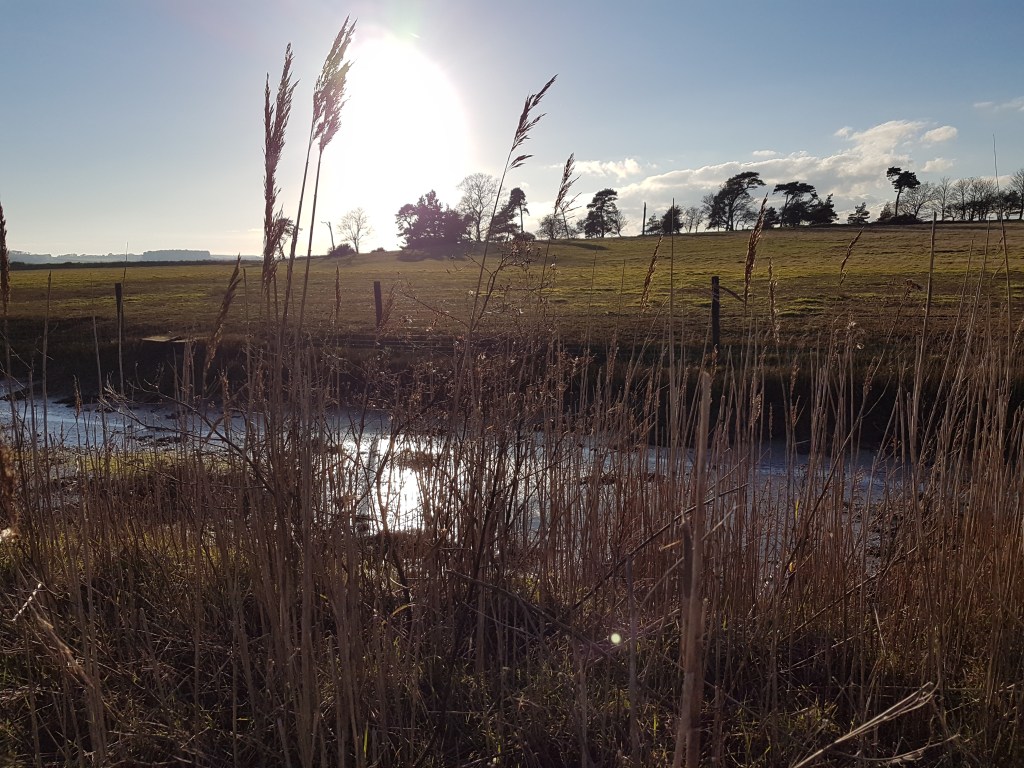
Finally, the peace of the winter sun on Hazlewood marshes, shows a reserve that continues to thrive and is home to many native and migratory birds.  But the area, like the rest of the estuary is subject to the forces of the North Sea and the ability of aging flood defences to withstand rising sea levels and consequent storm surges.

Embankment Wall Breach

In field studies on the Essex and Kent coasts following the North Sea 1953 storm surge, academics, Cooling and Marsland listed four possible causes for flood embankment failure. Three of these causes are particularly useful to consider regarding the failure of river walls at Hazelwood marshes and Havergate Island. These are, a) erosion of sea-facing embankment wall by wave activity, b) erosion of land-facing embankment due to over-topping, c) slippage or slump of land-facing wall due to water dripping through the bank.

The three causes of failure described above can be said to be examples of two distinct processes, Scouring and Desiccating Cracking. Of the causes listed above, a and b, can be associated with scouring and c can be attributed to desiccated cracking. The elements of each process and how they contribute to flood embankment failure will be considered in more detail.

The process of scouring can occur when water overtops a flood defence and reaches the ground on the landward side of an embankment in a state of turbulence, therefore, it could be said, erosion begins the moment the wave reaches the border between soil and water. The force that moves the wave interacts at speed with soil at the base of the landward side of a flood embankment. At this point, two processes are said to be at work, the immediate movement of the water directed by the physical space it hits and the state of the soil when the wave meets the ground.

The immediate area the wave hits is said to contribute to scour due to water meeting an obstruction, presumably this could be a rock or the edge of the base of the river embankment. Meeting this obstruction can interrupt flow and decrease its space and redirect surge water. As this alteration is very sudden and occurs at speed it can multiply the rapidity of the energy directing the water which can cause eddies to form.

The state of the soil the wave meets when it hits the ground, contributes to what is known as shear stress. Britannica.com define shear stress as an energy whose impact can distort a substance causing sliding along a horizontal surface alongside the source of the stress. The shear that occurs correlates to the descending progress of earth impacted by this process. The extent that shear stress causes a deep scour hole is related to the make-up of the soil at the base of the embankment, depending on soil makeup, sheer stress can lead to an eventual lifting of sediments particles causing scour.

A photo that was taken after the storm surge of December 2013 showing evidence of a shallow slippage, caused by scouring after wave overtopping.  

Photo from: https://www.google.com/search?q=AOEP-Estuary-web.4.compressed&rlz=1C1CHBF_en-GBGB894GB894&oq=AOEP-Estuary-web.4.compressed&aqs=chrome..69i57.1077j0j7&sourceid=chrome&ie=UTF-8

The second process that can cause an embankment to breach is Desiccated Cracking. This is particularly said to occur in alluvial clay, a material used in some flood defences in the Alde Ore estuary.

Desiccated Cracking or fissuring relates to the formation of an intersected web of internal vertical and horizontal fissures, about 60 cm deep within the surface layers of a flood embankment. It is thought repeated wetting and drying of estuary embankments can contribute to desiccated fissuring.

In a flood surge, large amounts of water drip through desiccated fissures, in extreme conditions, this can cause hydraulic fracture, when the flow transmits through fissures to the landward side of a river wall. Rather than a wave overtopping, water flows through fissures below the crest, into the embankment. This can cause the lifting of blocks of material, leading to gradual slope failure and the eventual breach of a river embankment.

Photo from: https://eprints.hrwallingford.com/1291/

Regarding, the process of water seepage that causes failure on the land-facing embankment, a member of the Alde Or Association visited Hazelwood marshes during the storm surge at its peak on December 6th 2013. It was reported that the water level reached the top of the embankment with minor overtopping at low points. However, the observation of real interest was amount of free water flowing through desiccation cracking issuing from the landward bank. This is indeed the puzzling aspect that strikes an outside observer of photos of the after-effects of the storm surge at Hazelwood, that they all seem to show water flowing outwards from the land-facing side of the embankment.

Photo from https://eprints.hrwallingford.com/1291/

The two processes of Scouring and Desiccated Cracking are separate yet are linked in that they interact and are influenced by the physical space and soil make-up of the flood embankment they detrimentally affect. Scouring interprets then shapes the space and the particles it interacts with, the scouring out of the base of a flood embankment, being the physical result of this interpretation. Whilst desiccated cracking, develops over time within the structure of the embankment, with the fissures functioning as vehicles for the rapid movement of water and its mechanisms of erosion.  

The tendency of recent storms to become ever more powerful and unpredictable alongside rising sea levels, make the complex processes of scouring and desiccated cracking increasingly useful to understand, so the effects of storm surges can be assessed to reduce the likelihood of flood embankment failures.