
This discussion will consider three particular elements to the on-going dramatic erosion at Thorpeness.

The first element is the flood defences installed in a series of attempts to hold back the sea. A Gabion defence, a stone filled mesh box was installed in 1976, following serious erosion with beach material added to cover the defence. However, storms in 2010 exposed this defence, so Geobags were installed at the bottom of the Gabion defence, but these in turn were seriously damaged in storms in 2013/14. Small rocks were then placed around damaged defences as a short-term measure in May 2021. In October of this year, a 35-metre rock revetment was installed below the fastest eroding section of cliff to protect property above.

The second element is a cairn made up of pieces of Coraline Crag that seems to symbolise what is solid and permanent and fragile and temporary at Thorpeness. A detailed report by Mott Macdonald outlines the geographical features that shape the beach morphology at Thorpeness. The Coraline Crag pieces have broken off a series of ridges that extend North-East from the end of North End Avenue. Historically, these ridges have been largely resistant to erosion. Another significant feature, the Sizewell Dunwich Bank Complex (SDBC) connects to a headland at Thorpeness, through the Coraline Crag ridges. The SDBC is sometimes extending towards Thorpeness with sediment from sources to the north accreting on the Ness, with beaches to the south starved of sediment. Sand may also move offshore from Thorpeness to the southern end of the SDBC.

This relationship is made more complex by observations of a shifting offshore bank which could focus wave energy onto North End Avenue, where erosion is particularly acute. Beach lowering, caused by sediment removal, could enable storm waves to reach the base of the cliff. This concurs with research by Earlie, Masselink and Russell from the Universities of Cardiff and Plymouth who compared contrasting beaches in Cornwall and found even though erosion was more constant at a beach, with a gentle foreshore, the beach with a steeper foreshore, saw massive erosion, when Mean High Water of a Spring Tide combined with a storm surge.
Wave energy can be reflected offshore by sand banks or defence structures and interact with an incident wave field. Constructive wave interference could see the crest or trough of a wave moving through or overlaying the crest or trough of another wave. This could heighten waves and drive sea floor currents and generate wave turbulence, which could drag additional sediment and hold it for longer, so even a weak current moving alongshore could remove beach sediment in larger quantities, than would be the case, were wave reflection to be absent. This lowers the beach further enabling larger waves to reach the shoreline driving further sediment loss. Notably, a future for Thorpeness state in the 6 months to August 2021, 10m of cliff were lost at the North end of the village in New Year storms.

The third element is the erosive forces themselves, in particular, Abrasion and Hydraulic action. Abrasion describes how bits of sand or rock in waves can grind down cliff surfaces like sandpaper, with boulders projected like strong hammers, pebbles like bullets and sand like abrasive powder.
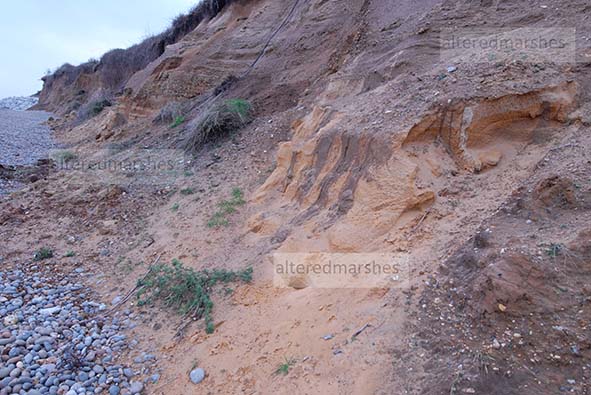
Regarding Hydraulic Action, waves propel air in advance of them and squeeze it against the cliff face. When the air is freed, it inflates with considerable force, destabilising and tearing away part of the cliff. In a connected process, Desiccated Cracking, the combined attrition of the weather and action of waves, can weaken a cliff face. Alternate heating and cooling cause the body of the cliff to expand and contract, creating cracks in which rain and sea water seep into crevices. When water freezes it expands massively, loosening segments of cliff face, additionally, when a cliff surface, dries and hardens, cracks can widen and deepen. Hydraulic actions, dampening and drying can cause large slippages of whole sections of sand and clay in a process known as sheer stress.
When standing on Thorpness beach, it is possible to envisage how these elements interconnect to facilitate erosion on this dynamic, fragile stretch of coastline.


 alteredcoast
One thought on “Elements of Erosion”